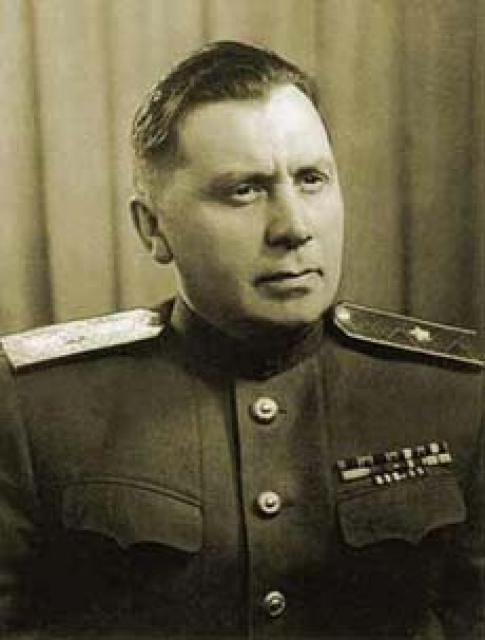
Naum Eytingon
- Early Life and Education
- Revolutionary Activities
- NKVD Career
- Operations in China, Turkey, and Spain
- Involvement in the Great Patriotic War
- Radio Game Operations
- Operation "Berezin"
- Post-War Career
Early Life and Education
Naum Isaakovich Eitingonwas born on December 6, 1899, in Shklov, Mogilev Governorate, into the family of a paper mill clerk. He completed seven grades at the Mogilev Commercial School. In April 1919, he was sent to Moscow for courses at the All-Russian Council of Workers' Cooperatives.
Revolutionary Activities
In September 1919, Eitingon returned to Belarus and participated in the struggle to restore Soviet power in Gomel as part of a communist detachment. In the spring of 1920, he was appointed to work in the Cheka (secret police) by the Gomel Regional Party Committee. At the age of 21, he became the deputy chairman of the Cheka for the Gomel Governorate.
NKVD Career
In May 1923, Eitingon was recalled to Moscow and became an authorized representative and later deputy head of a department in the Eastern Division of the OGPU (United State Political Administration). Simultaneously, he enrolled in the Eastern Faculty of the Red Army Military Academy.
After graduating in October 1925, Eitingon joined the Foreign Department of the OGPU and was soon sent as a resident external intelligence officer to Shanghai. From 1926, under the cover of being a vice-consul of the USSR in China, he headed the residencies in Beijing and, from 1927, in Harbin.
Operations in China, Turkey, and Spain
During his time in China, Eitingon secured the release of a group of Soviet military advisors captured by Chinese nationalists in Manchuria and thwarted an attempt by Chiang Kai-shek's agents to seize the Soviet consulate in Shanghai. In the spring of 1929, he was sent to Turkey, where he focused the residency's efforts on obtaining secret information from foreign embassies in Istanbul.
Upon his return to Moscow, Eitingon was appointed deputy head of the Special Group under the chairman of the OGPU. He made several trips abroad, including to California, USA, where he supervised the creation of a deeply covert network of agents. He also carried out assignments in France and Belgium.
In 1936, at the start of the Spanish Civil War, Eitingon, under the alias Leonid Aleksandrovich Kotov, was sent to Madrid. As "General Kotov," he was responsible for training Spanish state security forces, leading Republican partisan operations behind enemy lines, and conducting intelligence and counterintelligence work. Notably, Eitingon oversaw the shipment of over half a billion dollars worth of Spanish gold to Moscow.
Involvement in the Great Patriotic War
After the defeat of the Republicans in 1939, Eitingon organized the evacuation of Soviet specialists and volunteers from Spain to the USSR. In the spring of 1941, he returned to Moscow. Five days before the start of World War II, on June 17, 1941, he was awarded the Order of Lenin by a secret decree of the Presidium of the Supreme Soviet of the USSR.
From July 5, 1941, as deputy head of the Special Group under the People's Commissar of Internal Affairs of the USSR, Eitingon organized sabotage operations behind enemy lines and participated in the creation of the OMSBON (Separate Motorized Rifle Brigade of Special Purpose), which became famous for its missions behind the front lines.
Radio Game Operations
Eitingon played a leading role in two legendary radio game operations against German intelligence, "Monastery" and "Berezin." In these operations, Soviet agent Alexander Demyanov ("Heine") provided false information to the German Abwehr, leading them to make critical errors.
Operation "Berezin"
In August 1944, as part of Operation "Berezin," Eitingon used the captured German officer Heinrich Scherhorn to create a fictional German troop detachment that purportedly existed in the Belarusian forests. This operation misled the Germans and allowed the Soviet Union to gain valuable intelligence and strategic advantages.
Post-War Career
After the war, Eitingon was awarded the Order of Suvorov, 2nd degree, and the Order of Alexander Nevsky for his achievements. In 1945, he was promoted to the rank of major general of state security. He headed a special unit responsible for "atomic espionage" in the early stages of the Cold War.
In 1951, Eitingon was arrested as part of the "Zionist conspiracy" case within the MGB (Ministry of State Security). After Stalin's death in 1953, he was released from prison and reinstated in state security organs. However, in 1953, he was arrested again in connection with the "Beria affair" and sentenced to 12 years in prison. In 1964, Eitingon was released and later worked as an editor at the publishing house "International Relations." He passed away in 1981, and his rehabilitation came posthumously in April 1992.


