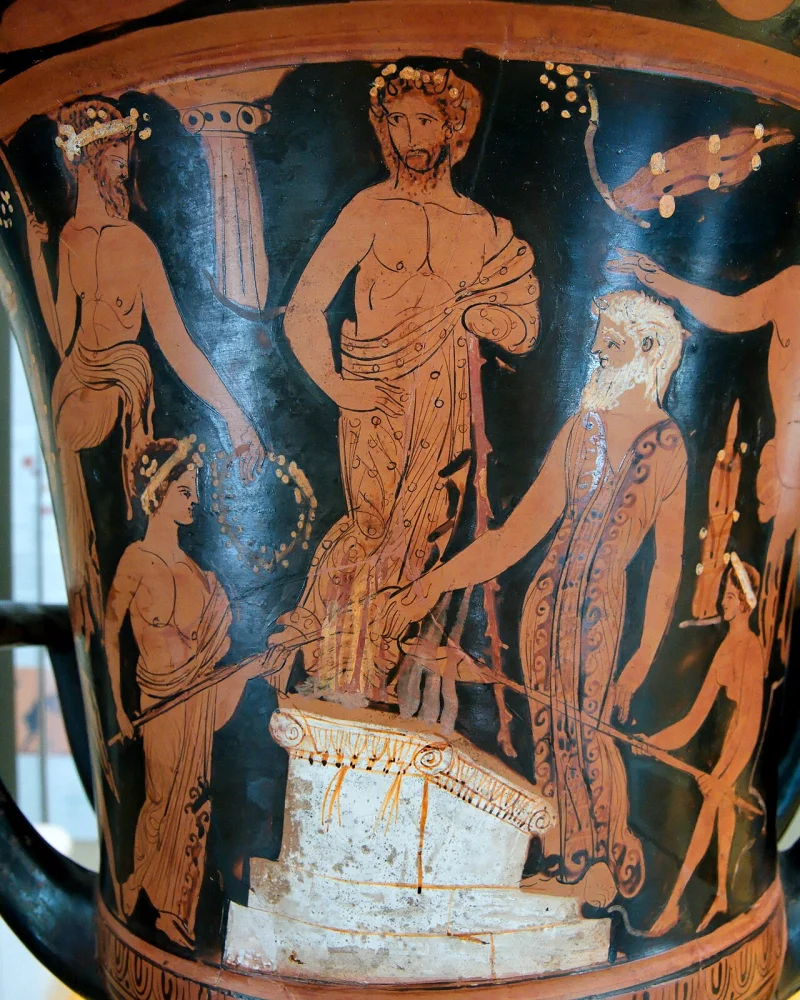
Nestor
Nestor is the elder statesman of Homer’s epics: a king whose long memory, measured advice, and gift for storytelling make him a steady presence among the Greek forces at Troy. He is not the strongest warrior in the camp, but his authority comes from experience and eloquence. In the Iliad, he counsels commanders and recalls heroic deeds from an earlier generation; in the Odyssey, his welcome to Telemachus links the aftermath of the Trojan War with the next generation’s search for home and identity.
King of Pylos
In Greek mythology, Nestor was the son of Neleus and Chloris and ruler of Pylos in Messenia. Later mythographers tell of Heracles killing Nestor’s brothers after a dispute with Neleus, while Nestor survived because he was away. Homer does not dwell on the episode, but his epithets and speeches suggest a hero whose life stretches across generations.
The Iliad presents Nestor as exceptionally old. He says that two generations of men have passed during his lifetime and that he now rules a third. This great age is part of the epic’s storytelling, not a realistic chronology. His past is almost a heroic history in itself: he remembers battles against the Centaurs and earlier adventures in which he fought alongside famous heroes. These recollections allow Homer’s audience to glimpse a world that precedes the war at Troy.
Nestor’s kingdom is associated with the archaeological site known as the Palace of Nestor, near modern Pylos in southwestern Greece. Excavations at Ano Englianos uncovered a major Mycenaean palace, destroyed around the end of the Bronze Age and remembered through the Homeric tradition. The site helps illuminate the world that later Greeks associated with Pylos, though archaeology cannot prove that the mythological king himself existed.
Counsel at Troy
In the Iliad, Nestor leads a contingent from Pylos and participates in the Greek campaign, but his age limits his ability to fight on the front line. Instead, he becomes a counselor to Agamemnon, Achilles, and other leaders. His speeches are long and rich with memories, often comparing the present warriors with the heroes of his youth. To Nestor, the past offers examples of courage and a reminder that cooperation matters.
When Agamemnon and Achilles quarrel, Nestor urges both men to restrain their anger and preserve the Greek alliance. His advice is sensible, but it does not resolve their conflict. Throughout the poem, he continues to advise the commanders, sometimes with practical suggestions and sometimes with stories of earlier battles. His power lies in persuasion, and Homer repeatedly presents him as a speaker whose words are respected even when they are not followed.
Nestor also plays a role in the story of Patroclus. In Book 11, after Nestor brings the wounded Greek fighter Machaon from the battlefield, he speaks with Patroclus and recounts a youthful exploit. The conversation helps set in motion the chain of events that leads Patroclus to enter battle wearing Achilles’ armor. Nestor’s tales are not merely nostalgic; within the poem, they influence the choices of younger men.
A Host in the Odyssey
Nestor appears again in the Odyssey, where Telemachus travels to Pylos seeking news of his father, Odysseus. The young prince arrives during a public sacrifice to Poseidon, and Nestor welcomes him warmly. He recounts the Greek fleet’s departure from Troy and the different fates of the returning heroes, including Agamemnon’s murder at home.
Nestor cannot tell Telemachus what happened to Odysseus, but he provides a model of hospitality and family life. He sends his son Pisistratus with Telemachus toward Sparta, where Menelaus may know more. His role in the Odyssey is quieter than his part in the war epic, yet it connects generations: Nestor’s memory helps guide a young man who has inherited the consequences of the Trojan War.
Legacy
Nestor became an enduring image of wise counsel and old age in Greek literature. His lengthy speeches could be mocked by later readers as overlong, but in Homer they carry social authority. He knows how to preserve the memory of the past, and his stories give meaning to the conflicts of the present.
The name “Nestor” has since become a byword for a respected elder whose advice deserves a hearing. The character’s lasting appeal lies in the balance between wisdom and limitation: he can see what younger warriors fail to see, but he cannot compel them to act. Through Nestor, the epics explore the value of experience, the power of speech, and the fragile connection between one generation and the next.