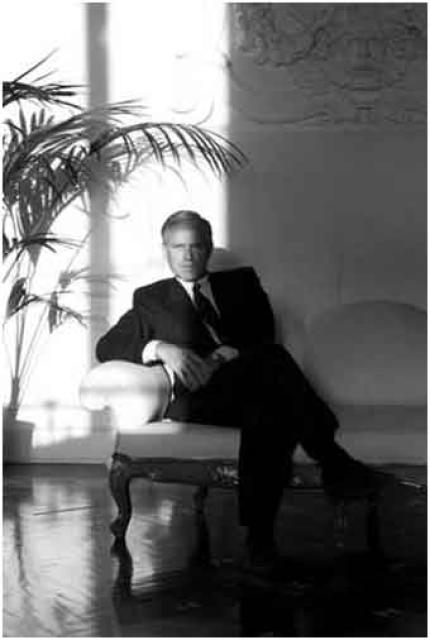
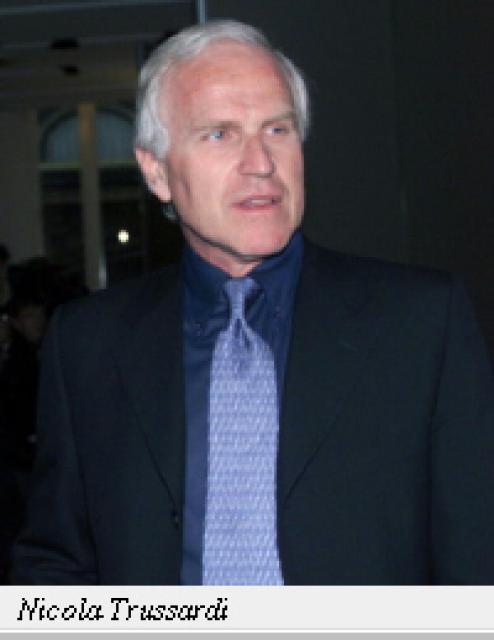
Nicola Trussardi
 Italy
Italy- Biography of Nicola Trussardi
- Early Life and Career
- Building a Fashion Empire
- Entry into Fashion Design
- Trussardi's Style
- Expansion and Tragic Loss
- Continuing the Legacy
Biography of Nicola Trussardi
Italian DesignerNicola Trussardi was born on May 17, 1942. Combining the talents of an artist and a manager, he turned his family business into one of the leading fashion companies in the world. Trussardi revolutionized the world of high fashion by introducing leather clothing into his collections. He always emphasized, "Leather remains my passion, our tradition."
Early Life and Career
In 1910, in the small Italian town of Bergamo, near Milan, Nicola's grandfather Dante Trussardi opened a small glove-making company. The firm grew, and soon the high-quality leather gloves became popular among buyers. In 1970, after the death of his father and uncle, Nicola inherited the family business. At that time, he had just graduated from the economics department of the Catholic University of Milan and had no plans to pursue a career in design. However, he became a determined and competent entrepreneur in his work at the company.
Nicola's first step as the new leader was purchasing a small tannery. He thoroughly studied new leather processing methods, delving into all the details of the production process. Eventually, the application of new technologies allowed the fashion house to significantly reduce the cost of its products. Affordable raw materials, after the appropriate treatment, acquired perfect parameters and appeared indistinguishable from expensive leather.
Building a Fashion Empire
After gaining expertise in leather production, Trussardi assembled a powerful design team. Over the years, famous designers such as J. Scott and N. Greguar worked for him. In 1973, Trussardi introduced leather goods - bags, suitcases, and small leather accessories - with a new logo, which quickly gained recognition for their design, excellent leather craftsmanship, practicality, and versatility. The brand's logo, an elegant greyhound symbolizing speed and constant progress, reflected Nicola Trussardi's own character traits.
Inspired by this success, Nicola expanded the production to include men's accessories such as wallets, shoes, belts, and umbrellas. The company's profits grew to such an extent that in 1976, Trussardi opened his first store in Milan under his own name. By the late 1990s, the Trussardi store network included 183 boutiques worldwide, including stores in Paris, St. Petersburg, Moscow, Singapore, Hong Kong, and Tokyo. The fashion house also established several joint ventures in Europe, the United States, and Japan.
Entry into Fashion Design
Nicola began creating clothing collections as an established designer. In 1983, he presented his first women's collection, followed by a men's collection in 1984. These collections were enthusiastically received, and Trussardi gained recognition among his colleagues in the industry. Another distinguishing feature of Trussardi's style was his passion for theatrical effects, turning each fashion show into a vibrant spectacle. He showcased his collections on prestigious stages in Milan and around the world, often choosing unique locations and settings, such as the Duomo Cathedral, the Sforza Castle, the Brera Academy, and the Hermitage in St. Petersburg.
Trussardi's theatrical talents also extended to his work as a stage designer. He created costumes for Jose Carreras' performance in 1986 and theatrical costumes for the opera production of Giuseppe Verdi's "Macbeth."
Trussardi's Style
The Trussardi fashion house embraced three fundamental concepts: dynamism, simplicity, and naturalness. Although a proponent of classic style, Nicola infused his clothing designs with innovative fabric experiments, exploring various textiles. He aimed to create simple, comfortable, and functional garments with exceptional designs using relatively affordable but high-quality materials. He believed that every customer could find their perfect outfit at Trussardi stores.
Trussardi's designs always featured leather goods as an integral part of his collections. Thanks to his efforts, leather clothing became a staple in the world of high fashion. He continuously emphasized, "Leather remains my passion, our tradition."
Expansion and Tragic Loss
Trussardi released one collection after another, expanding his fashion empire. In the late 1980s, the Trussardi fashion house launched new clothing lines that immediately gained popularity. Nicola also had a particular love for sportswear. As a passionate sports enthusiast, a skilled driver, and a sports airplane pilot, he conducted research with his design team on various materials for sportswear. Trussardi's laboratories explored the latest fabrics, from microfibers to breathable and waterproof materials. The result of these experiments was the Trussardi Sport collection launched in 1989. Trussardi was even invited to design the sports uniforms for the Italian national team at the 1987 Seoul Olympics.
In 1991, Trussardi presented the Trussardi Couture collection, venturing into the world of haute couture. In the spring of 1996, he opened the T-Store, a line of high-quality clothing for young people. Trussardi's children - Beatrice, Francesco, Gaia, and Tomaso - became the faces of the youth line.
Tragically, on April 15, 1999, Nicola Trussardi's life was cut short. A passionate lover of speed, the 56-year-old designer was involved in a car accident and passed away in a Milan hospital without regaining consciousness.
Continuing the Legacy
Trussardi always emphasized that his business was a family affair, involving his wife and four children: Beatrice, Francesco, Gaia, and Tomaso. They were the "support and backbone" of the Trussardi family business, and he "loved and was proud of them." His wife, Maria Luisa, led the women's and children's clothing lines and designed original fabric patterns. Shortly before Nicola's death, he appointed her as the creative director and his successor. However, she passed on the management of the family business to their children. After their father's death, Beatrice and Francesco took over the fashion house. Francesco became the director of Finos Group, which owned Trussardi, and achieved a 3% improvement in the company's performance, earning €125 million in 2002.
Beatrice mainly focused on fashion design at the Trussardi fashion house and oversaw the Nicola Trussardi Foundation, established by Nicola himself in 1996. The foundation's goal, supported by the Italian Chamber of Fashion, is to support young and talented designers. The "Fashion Valley," created by Trussardi, aims to "develop the art of cutting and sewing in harmony with other forms of art."
Unfortunately, Francesco's plans for the future were also tragically cut short. On January 27, 2003, similar to his father, he died in a car accident near Bergamo.
Currently, Beatrice Trussardi leads the Trussardi fashion house. In May 2003, the young designer and entrepreneur received the prestigious Marisa Bellisario Award, recognizing her as the "Manager of the Year" in the Italian business world. The fashion empire built with the energy and talent of Nicola Trussardi not only maintained its position in the fashion world but also continues to thrive. The swift greyhound depicted in the globally renowned logo runs farther and farther into the future.


