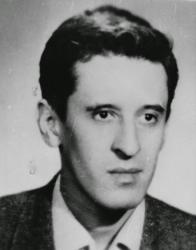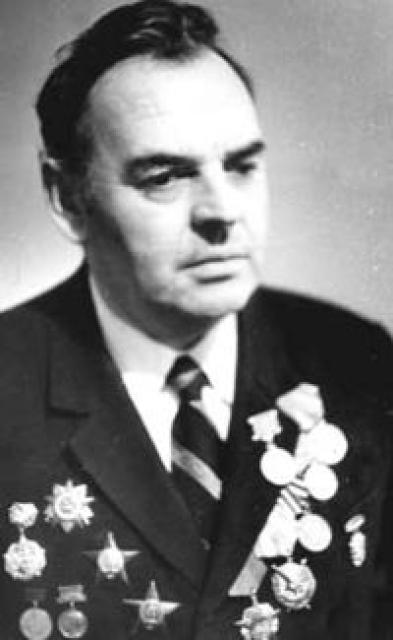
Nikolay Ribalko
 Ukraine
Biography of Nikolay Rybalko
Nikolay Rybalko was a Ukrainian poet who was born on February 14, 1922, in the village of Orekhovo-Vasilievka. In 1931, his family moved to Kramatorsk, which became his hometown. He completed his education at School No. 1, where he finished 10 grades. Afterward, he became a student at Dnipropetrovsk State University. For his entrance essay on the Ukrainian language and literature, he wrote it in verse and received a top grade for his composition on the topic "Soviet aviators - proud falcons of the socialist country." However, his studies at the Philological Faculty were interrupted by the start of the Great Patriotic War.
Among others, Nikolay Rybalko volunteered to join the front. He was accepted into the Barnaul Mortar School in June 1942. Lieutenant Rybalko had his first battle near Voronezh, where he was wounded for the first time and received his first award - the Order of the Red Star. Under his command, the anti-tank battery participated in many bloody battles, including the largest tank battle near Prokhorovka on the Kursk Bulge. As part of the 38th Army, Nikolay Alexandrovich fought in the liberation battles across Ukraine - from Sumy to Lviv. He was awarded the Order of the Red Banner for crossing the Dnieper south of Kyiv. There were also battles near Korsun-Shevchenkovsky, where he was wounded again and received another award - the Order of the Red Star. He advanced through Poland during the liberation battles and reached the Oder River. He welcomed the year 1945 on German soil.
In February 1945, on the Oder bridgehead, Guard Captain Rybalko was seriously wounded. He underwent months of treatment in hospitals, but medicine, unfortunately, was powerless, and he permanently lost his sight. He was only 23 years old at the time. However, the war did not end for him in 1945; for him, the poetic word became his weapon. His first poem, "Flowers," was published in 1954 in the "Literary Gazette." The author received numerous warm and encouraging reviews. Just two years later, Nikolay Rybalko brought his manuscript of a book of his poems to the Donbass publishing house. In 1956, his first collection, "Under the Sun of the Homeland," was released, which received attention from both the public and professionals. The author of the collection was accepted as a member of the Union of Writers of the USSR.
In the following years, new collections were published. Nikolay Alexandrovich Rybalko published over 25 books throughout his life. All his collections of poems, including "Eyes of the Heart" (1958), "I Lived in Such Times" (1972), "Unsetting Star" (1982), "Forget-me-nots on the Mound" (1975), and many others, spoke not only of the difficult times of war, but also of human friendship, loyalty, and love. In 1966, his essay "Armor and Flame" was published, in which the author tells the story of his school friend, Yevgeny Lysenko. Lieutenant Colonel E. P. Lysenko was only twenty-four years old when he was fatally wounded. Nikolay Rybalko's work has been honored with numerous high government awards, including the Order of the October Revolution and the Order of Friendship of Peoples. In 1968, he received the title of laureate of the republican Komsomol Prize named after Nikolay Ostrovsky for his collection "Road to the Heights." In 1985, he was awarded the title of laureate of the State Prize of Ukraine named after T. G. Shevchenko for his collection "Unsetting Star." Alexander Bilyash's song based on the poems of N. A. Rybalko, "I Lived in Such Times," became a laureate of the All-Union TV competition "Song-75."
Nikolay Rybalko's public activities are widely known. For over forty years, he led the literary association at the editorial office of the "Kramatorskaya Pravda" newspaper, which was considered one of the best in Ukraine. Many talented writers, including Oleg Plutalov, Leonid Gorovoy, Viktor Pikalov, Anatoly Mironenko, and Anatoly Miroshnichenko, were brought up within this association. After his death, Donetsk writers decided to establish a competition in his name.