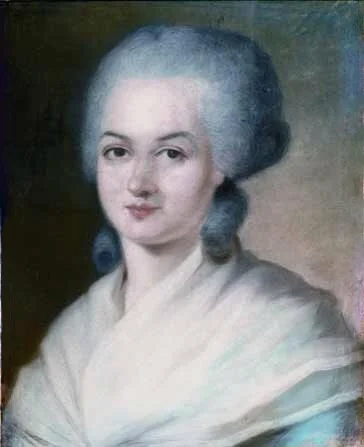
Olympe de Gouges
Olympe de Gouges wrote as if the promises of the French Revolution should apply to everyone. A playwright and political activist, she challenged slavery, defended women’s civic and legal rights, and criticized revolutionary leaders when she believed they were concentrating power. Her boldest manifesto, the 1791 Declaration of the Rights of Woman and of the Female Citizen, exposed the gap between universal ideals and women’s exclusion from public life.
From Montauban to Paris
Born Marie Gouze in Montauban on 7 May 1748, she married young and was widowed while still in her twenties. She later moved to Paris, where she adopted the name Olympe de Gouges and began a new life in literary and political circles. Largely self-educated, she developed a public voice through plays, pamphlets and open letters.
Her early writing addressed social injustice as well as theatrical subjects. In the 1780s, she wrote against the slave trade and slavery in France’s colonies. Her play *Zamore and Mirza* explored the violence of enslavement and provoked controversy when staged. She continued to argue that a society claiming to prize liberty could not credibly defend colonial bondage.
The rights of women
The French Revolution began in 1789 with a language of liberty and equality, but the new political order largely excluded women from formal citizenship. De Gouges responded in 1791 with her Declaration of the Rights of Woman and of the Female Citizen, modeled on the Declaration of the Rights of Man and of the Citizen. It argued that women should enjoy the same civil and political rights as men, including participation in lawmaking and public office.
The text’s opening reverses the era’s assumptions: “Woman is born free and remains equal to man in rights.” De Gouges also called for equality in marriage and inheritance, and challenged the double standards that constrained women’s choices. She pressed Marie Antoinette to support women’s cause, believing that a prominent woman at court might help secure change.
A fiercely independent political voice
De Gouges did not belong neatly to one revolutionary faction. She supported popular sovereignty and social reform, but opposed the execution of Louis XVI and argued that France’s future should be decided by a broader public process. She criticized the National Convention and warned against concentrating authority in the hands of a small group.
In 1793, as the Revolution entered its most violent phase, she published *The Three Urns*, proposing that voters choose among different forms of government. Authorities treated the pamphlet as an attack on the Convention’s legitimacy. She was arrested in July, tried by the Revolutionary Tribunal and executed by guillotine in Paris on 3 November 1793.
Her trial reflected the crackdown on dissent during the Terror. Although her advocacy for women’s rights was central to her legacy, historians note that her direct criticism of the Convention and her proposal for a popular vote were key elements in the case against her.
Legacy
For generations, de Gouges was remembered less often than the male authors of the Revolution’s founding texts. Her writing later became central to histories of feminism, human rights and abolitionism. She insisted that political ideals had to be tested by the lives of women, enslaved people and others denied a voice.
One of her best-known lines captured the danger and the demand in her public life: if women had the right to mount the scaffold, they should also have the right to speak from the political rostrum. Her work remains a powerful reminder that universal rights can remain selective unless people excluded from power insist on being counted.