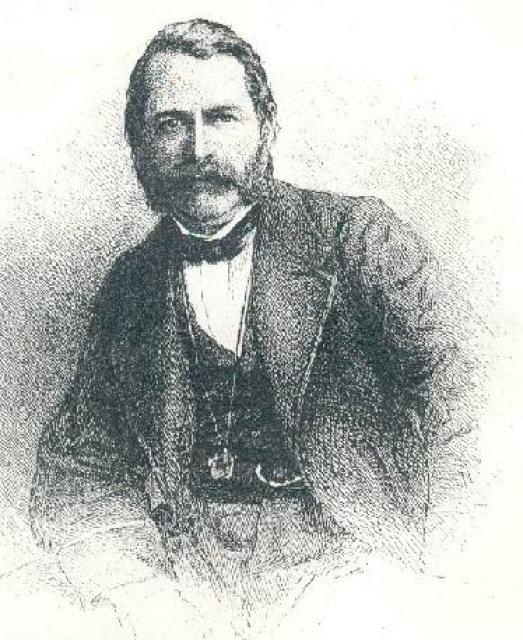
Osip Rabinovich
 Italy
ItalyBiography of Osip Rabinovich
Osip Rabinovich was a Russian prose writer, journalist, representative of Russian-Jewish literature, editor, and public figure. He was born into a wealthy Jewish family and spent his childhood at the Lugansk Foundry, where he received a home education combining European and Jewish disciplines. At the age of 23, he enrolled in the medical faculty of Kharkov University but had to leave due to the deterioration of his family's financial situation. In 1845, he moved to Odessa with his wife and daughter, where he was accepted as a lawyer in the commercial court. In early 1848, he became a public notary, opened his own office, and had an extensive legal practice.
Early Career and Literary Achievements
Osip Rabinovich made his debut in Russian journalism with articles in the "Odessa Herald" in 1847-1848. In Russian literature, he gained recognition for his translation from Hebrew of Yakov Eichenbaum's poem "Gakrab" ("Gakrav" - Battle, Odessa, 1847), which received good reviews in the St. Petersburg magazine "Library for Reading." His stories "The History of the Trading House 'Firlich and Co.'" and "Moritz Sefardi" were published in two issues of the Odessa almanac "Literary Evenings" in 1849-1850. Among the authors of this almanac were later well-known poets Yakov Polonsky and Nikolay Sherbin.
Later Career and Recognition
From the 1850s onwards, Osip Rabinovich published prose and articles in St. Petersburg journals such as "Contemporary," "Russian Word," "Library for Reading," Moscow's "Russian Messenger," and others. His most famous work is the novella "The Story of How Reben Haim-Shulim Feigis Traveled from Kishinev to Odessa, and What Happened to Him" (1865). He authored numerous books of prose, journal and newspaper publications, brochures, and a three-volume collected works published posthumously.
During the reform period of the 1850s-1860s, together with I. Tarnopol, Rabinovich obtained the right to publish the first Russian-Jewish journal "Rassvet" (Odessa, 1860-1861), aimed at defending the civil and national interests of Jews in Russia, and he served as its editor until its closure. In the 1860s, he was a member of the Odessa City Duma and participated in the preparation of a new city code. With the publication of his collected works in three volumes (St. Petersburg, Odessa, 1880-1888) after his death, he gained the status of a "pioneer of Russian-Jewish literature." His works have not been reprinted in Soviet years.
In modern research, Osip Rabinovich is recognized as one of the founders of the Odessa literary tradition, which found further development in the works of Semen Yushkevich, Isaac Babel, and other Odessa writers.