Ostap Vishnya
 Ukraine
Biography of Ostap Vishnya
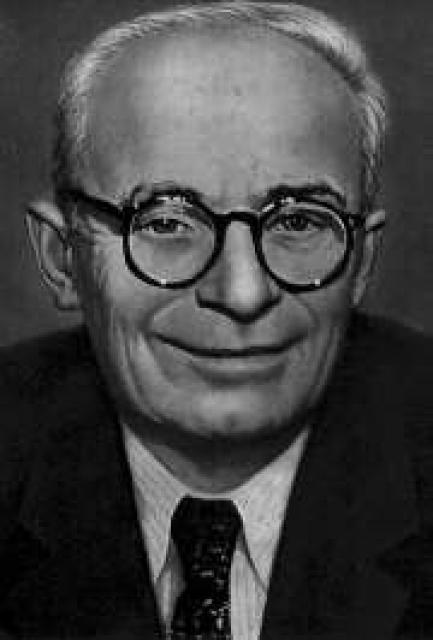
Ostap Vishnya was a Ukrainian writer, humorist, and satirist. He was born on November 13, 1889, in the hamlet of Chechva near the town of Grun in the Zin'kovsky district of the Poltava province (now the Akhtyrsky district of the Sumy region) into a large peasant family with 17 children. He completed his primary education and then attended a two-class school in Zen'kove. Vishnya continued his education at a military medical school in Kyiv, and after graduating in 1907, he worked as a field medic, first in the army and eventually in the surgical department of the Southwest Railway Hospital.
However, Vishnya had no intention of dedicating himself to medicine. While working at the hospital, he focused on self-education. In 1917, after passing his final high school exams externally, he enrolled in Kyiv University, but soon abandoned his studies to fully devote himself to journalism and literary work. His first published work, "Democratic Reforms of Denikin," appeared on November 2, 1919, in the newspaper "Narodna Volya" under the pseudonym "P. Grunsky." Several more satirical pieces by the young writer were published in the same newspaper. In April 1921, when he became a worker for the republican newspaper "Visti VUTsIK," a period of active creative activity and regular press appearances began for him. The pseudonym "Ostap Vishnya" first appeared on July 22, 1921, in the "Krestyanska Pravda" under the satirical piece "Wonder, I swear!"
Vishnya mercilessly mocked weaknesses: his own, those of his fellow countrymen, believing, like Gogol, that "those who no longer have the spirit to laugh at their own shortcomings are better off not laughing at all." He particularly ridiculed the weakness of Ukrainians for civil and national unity, their inertia, and anachronistic traits in the psychology and thinking of Ukrainians, which were costly for Ukraine. During his inspired work, Vishnya created and developed a new genre - the "usmeshka."
"Usmeshka" is a variety of feuilleton and humoristic writing. Vishnya coined this term himself. Later, he wrote, "Although the word 'feuilleton' has already earned the right to exist among us, in my opinion, the word 'usmeshka' ... is more appropriate." The author of "Vishnya's Usmeshki" continued to master and develop the traditions of national and world literature and folk creativity, primarily the traditions of the classics, such as Gogol and Shevchenko, Saltykov-Shchedrin and Franko, Martovych and Chekhov.
In 1933, Vishnya was illegally repressed on false charges of attempting to assassinate a state official (sentence - ten years) and was only able to resume his literary activities in 1943. Vishnya's wife, Varvara Alekseevna Maslyuchenko, like the wives of the Decembrists, managed to serve her sentence alongside her husband through her connection to Maxim Gorky. She settled in a small town near the camp on the Kola Peninsula. However, she could hardly see her husband and could only correspond with him. In 1934, their correspondence was interrupted for five years.
In 1955, Ostap Vishnya (and his brother, also a writer, posthumously) was rehabilitated. After rehabilitation, Vishnya returned to Kyiv. He died of a heart attack in 1956. In 1991, a film titled "From the Life of Ostap Vishnya" about the writer's time in the camp and his loyal wife was released at the Alexander Dovzhenko Film Studio, with Bogdan Stupka playing the role of the writer.