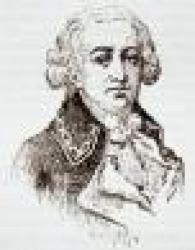
Otto Kotzebu
 Russia
- Otto von Kotzebue: A Renowned Russian Navigator
- The "Rurik" Expedition (1815-1818)
- Legacy of the "Rurik" Expedition
- The "Predpriyatiye" Expedition (1823-1826)
- Later Career and Honors
Otto von Kotzebue: A Renowned Russian Navigator
Early Life and InfluencesBorn on December 18, 1788, in Revel, Estonia (now Tallinn), Otto von Kotzebue hailed from a prominent family. His father was the renowned writer August von Kotzebue. At the age of eight, young Otto enrolled in the First Cadet Corps, intended for training officers in the army. However, his passion lay elsewhere, and he embarked on a maritime career.
In 1803, he joined the sloop "Nadezhda" as a volunteer for the first Russian global expedition. This three-year voyage under the command of Ivan Kruzenshtern transformed Kotzebue into a seasoned sailor. Not only did he acquire the necessary knowledge and skills, but he also embraced the prestigious traditions of the Russian Navy. It was during this expedition that Kotzebue developed a deep interest in scientific exploration.
The "Rurik" Expedition (1815-1818)
In 1815, Kotzebue commanded the brig "Rurik" on its groundbreaking scientific expedition. This voyage was unique as it prioritized scientific objectives rather than transportation or supply missions. Funded by Count Nikolay Rumyantsev, a renowned patron of the arts and sciences, the "Rurik" embarked on a mission to explore the equatorial and tropical regions of the western Pacific Ocean.
Legacy of the "Rurik" Expedition
Chart Corrections and Discoveries:Kotzebue meticulously corrected errors in the positions of islands previously charted by foreign navigators. He also removed nonexistent islands that had been erroneously reported. Additionally, Kotzebue discovered numerous new islands, including the Rumyantsev Group and the Arakcheev Islands.
Hydrographic and Magnetic Studies:The "Rurik" performed extensive hydrographic surveys, including charting coastlines, determining astronomical coordinates, and assessing conditions for navigation. The expedition also conducted magnetic observations to enhance knowledge of Earth's magnetism.
Natural History and Ethnology:Scientists onboard the "Rurik" collected valuable data on natural history, ethnology, and various other disciplines. These scientists included Adelbert von Chamisso, Wilhelm Wormskiold, Johann Eschscholtz, and Ludwig Choris, who documented the expedition's findings.
The "Predpriyatiye" Expedition (1823-1826)
In 1823, Kotzebue led the sloop "Predpriyatiye" on a scientific circumnavigation. This expedition was initially intended to transport supplies to Russian America but was later repurposed for scientific research. LENZ, a physics student who would later become a prominent physicist, played a pivotal role in establishing the expedition's significance in the nascent field of oceanography.
Later Career and Honors
After his remarkable circumnavigations, Kotzebue continued his naval service and made significant contributions to Russian maritime history. He published detailed accounts of his expeditions, notably "A Voyage of Discovery into the South Sea and Bering's Straits, for the Purpose of Exploring a North-east Passage" (1821). Kotzebue received numerous honors, including a promotion to Captain-Lieutenant and the prestigious Order of St. Anna.