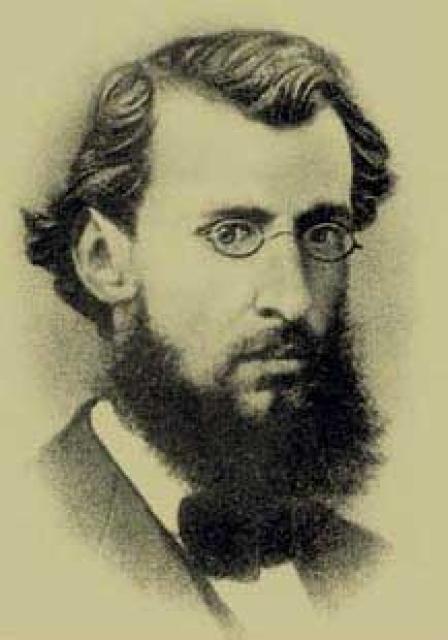
Panas Mirnyi
 Ukraine
Biography of Panas Mirnyi
Panas Mirnyi was a Ukrainian writer who actively participated in public activities without publicizing his literary work. Born as Afanasiy (Panas) Yakovlevich Rudchenko on May 13, 1849, in Mirgorod, Poltava Oblast, he grew up in a family of a district treasury accountant. After completing his education at the Mirgorod Parish School and later at the Hadiach District School, the fourteen-year-old boy started working.
Career in Civil Service
Rudchenko began his career as a civil servant in 1863 at the Hadiach District Court. The following year, he moved to the district treasury as an assistant accountant. After a brief stay in Pryluky, he took up the same position in the Mirgorod Treasury. During his first eight years as a civil servant, Rudchenko embarked on his first literary experiments and collected folklore materials, some of which were later published by his brother under the pseudonym Ivan Bilyk in the collections "Narodni Yuzhnoruski Skazky" (1869, 1870) and "Chumatski Narodni Pesni" (1874). From 1871, Panas Rudchenko lived and worked in Poltava, holding various positions in the local treasury. It was during this time that he began his literary career, inspired by his older brother Ivan, who had been publishing his folklore materials in "Poltavskie Gubernskie Vedomosti" and "Osnova" since the early 1860s. Ivan also translated Turgenev's stories into Ukrainian and wrote critical articles for the Lviv journal "Pravda."
Early Works
Panas Mirnyi's first works, the poem "Ukraini" ("To Ukraine") and the story "Lihyi Poputav" ("The Mischievous Wanderer"), were published under the pseudonym Panas Mirnyi in the Lviv journal "Pravda" in 1872. However, due to censorship restrictions on Ukrainian-language literature, most of his works remained unknown to the wider public in Ukraine during the 1870s and 1880s. They were primarily published abroad. For example, in 1874, the journal "Pravda" published his essay "Podorizhzhia od Poltavi do Hadiachoho" ("Journey from Poltava to Hadiach") and the story "P'ianytsia" ("The Drunkard"). In 1877, his novella "Lihy Liudy" ("Miserable People") was published in Geneva. In 1875, he completed the novel "Khiba Revut Voli, Yak Yasla Povni?" ("Do the Scythes Reap While the Hay Is Tall?") in collaboration with his brother Ivan Bilyk. Although it was submitted for censorship, it was not published in Russia due to the so-called Ems Ukaz of 1876. The novel was finally published in Geneva in 1880. It was only in the mid-1880s that Panas Mirnyi's works began to be published in Ukraine, starting with the almanac "Rada," edited by M. Staritsky, which published the first two parts of his novel "Povia" and two stories from the cycle "Yak Vedyt'sia, Tak I Zhyvet'sia." In 1886, a collection of his works titled "Zbiranytsia z Ridnoho Polia" ("Collection from the Native Land") and a comedy called "Peremudriv" ("The Know-It-All") were published in Kyiv. At the same time, Panas Mirnyi continued to collaborate with Galician (Austro-Hungarian) collections and journals, where his works such as "Lovyi" ("The Hunter"), "Kazka pro Pravdu ta Kryvdu" ("The Tale of Truth and Injustice"), "Limeryvna" ("The Limeryvna"), and a free translation of "Duma pro Viysko Ihoreve" ("The Lay of the Host of Igor") were published.
Public Involvement
Although he did not publicize his literary activities, Mirnyi actively participated in public life. In his youth, he was associated with the revolutionary circle "Uniia" in Poltava. During a search at his place, prohibited publications were found, but he faced no consequences. Mirnyi maintained close connections with many prominent figures of Ukrainian culture, such as N. Lysenko, M. Staritsky, I. Karpenko-Karyi, M. Kropyvnytskyi, M. Kotsiubynskyi, L. Ukrainka, M. Zankovetska, K. Bililovskyi, and Zharko. As a member of the city council's commission, he actively participated in the construction of a monument to Ivan Kotliarevskyi in Poltava. After the issuance of the imperial manifesto in 1905, Mirnyi published articles advocating for women's equality. He collaborated with the journal "Ridnii Krai," which began publishing in Poltava in 1905. In several of his works, such as "Do Suchasnoi Muzi" ("To the Contemporary Muse"), "Son" ("Dream"), and "Do Brativ-Zaslanetsi" ("To the Exiled Brothers"), he commented on the revolutionary events.
Later Years and Legacy
When the celebration of Taras Shevchenko's 100th anniversary was banned in 1914, Mirnyi protested vehemently against the actions of the imperial authorities in an article. In 1915, the police began searching for the "politically suspicious person" Panas Mirnyi. He never revealed his pseudonym, as he did not want his writing career to hinder his professional career, so his true identity remained unknown to the authorities. After the 1917 revolution, Mirnyi supported the Central Rada and later Symon Petliura. Mentions of this can be found in the literary encyclopedia published in the 1930s. However, Soviet criticism later portrayed Mirnyi as a supporter of the Soviet regime, under which, despite his age, he worked in the Poltava Provincial Financial Department.
Panas Mirnyi passed away and was buried in Poltava. In accordance with the decree of the Council of People's Commissars of the Ukrainian SSR, his residence from 1903 became a literary memorial museum. In 1951, a monument to Mirnyi was erected in Poltava. The novel "Povia" by Panas Mirnyi served as the basis for the feature film "Hulyashcha" ("The Carefree") directed by I. Kavaleridze, with L. Gurchenko playing the role of Khrystyna.


