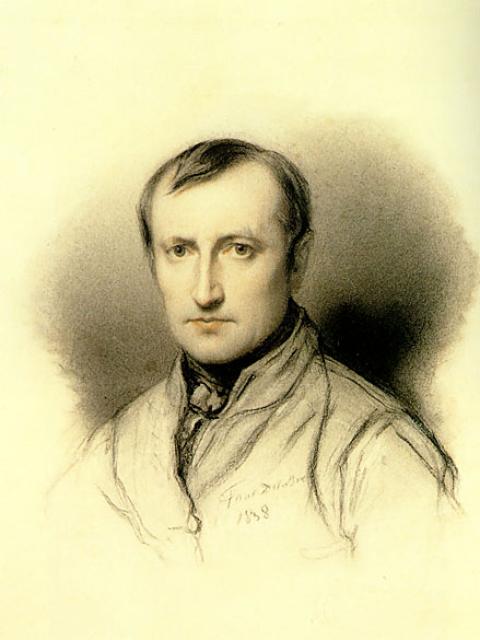
Paul Delarosh
 France
Biography of Paul Delaroche
Paul Delaroche was a renowned French historical painter and representative of academicism. His real name was Hippolyte, but he was known as Paul both among his contemporaries and in the history of art. Born into an artistic family, Delaroche's father was an expert in paintings and his uncle served as the curator of the engraving cabinet at the Paris Public Library. Growing up in this artistic atmosphere, Delaroche initially showed an inclination towards landscape painting and studied under Louis-Étienne Watelet. However, he soon switched to studying historical painting under Antoine-Jean Gros and later worked under Baron Gérard for four years.

In 1832, Delaroche gained considerable fame and was elected as a member of the French Institute. The following year, he became a professor at the Paris School of Fine Arts. In 1834, he traveled to Italy where he married the only daughter of the painter Horace Vernet and spent three years there.
Artistic Career
Delaroche first presented his work to the public at the Paris Salon in 1822 with the painting "Joseph saving Joachim," which still strongly reflected the style of Gros but showcased his exceptional talent. In subsequent works exhibited at the Salon in 1824, Delaroche was already largely free from the influence of his teacher and academic routines. Some of these works include "The Love of Filippo Lippi for His Novice," "Cardinal Archbishop Winchester Interrogates Joan of Arc in Her Cell," and "St. Vincent de Paul Preaching before the Court of Louis XII."
Delaroche aligned himself with the new ideas of the leader of the Romantic school, Eugène Delacroix. Guided by a keen intellect and refined aesthetic sensibility, Delaroche incorporated these ideas into his own work with restraint, avoiding excessive dramatic effects. He carefully considered his compositions and skillfully utilized his technical knowledge. His paintings, depicting scenes from English and French history, received unanimous acclaim from critics and soon became popular through engravings and lithographs. Some notable works include "The Children of Edward IV in the Tower of London," "The Cardinal Leading His Prisoners Saint-Mars and De Thou," "Mazarin Dying Amidst Courtiers and Ladies," "Cromwell at the Coffin of Charles I," "The Execution of Lady Jane Grey," and "The Assassination of the Duke of Guise."
After his return to Paris from Italy in 1834, Delaroche exhibited his work at the Salon in 1837, displaying paintings such as "Lord Stafford Going to Execution," "Charles Stuart Insulted by Cromwell's Soldiers," and "Saint Cecilia." From then on, he chose to showcase his completed works to art enthusiasts in his studio rather than participate in public exhibitions.
The Hémicycle Fresco
Between 1837 and 1841, Delaroche worked on the masterpiece of his life, the "Hémicycle." This colossal wall fresco measuring 15x4.5 meters depicts 75 great artists from the past. It adorns the amphitheater of the auditorium in the oldest art school in the world, the Paris School of Fine Arts. In this majestic and multi-figured composition, Delaroche allegorically represents the arts crowning the greatest artists from antiquity to the 17th century with wreaths. The central figures on thrones are the sculptor Phidias, the architect Ictinus, and the painter Apelles. This monumental work, harmonizing with the architecture and purpose of the space, is characterized by its beauty, variety of groupings, vibrant colors, and virtuosity of execution. Since the autumn of 2013, restoration work funded by American fashion designer Ralph Lauren has been carried out on the fresco.
In the 1840s, Delaroche mainly focused on themes from sacred and church history. After his second trip to Italy in 1844, he became interested in scenes from Italian daily life. One of his notable works from this period is "Rest on the Banks of the Tiber" housed in the Hermitage Museum. After the death of his wife in 1845, he turned to tragic subjects that expressed the struggle between man and an unyielding fate.
Some of Delaroche's remarkable works from the later period of his career include "The Descent from the Cross," "The Virgin Mary during Christ's Procession to Golgotha," "The Virgin Mary at the Foot of the Cross," "The Return from Golgotha," "Christian Martyr from the Time of Diocletian in the Tiber" (Hermitage Museum, Saint Petersburg), "Marie Antoinette after Receiving her Death Sentence," "The Last Farewell of the Girondists," "Napoleon in Fontainebleau" (Leipzig Museum), and the unfinished "The Rock of St. Helena."




