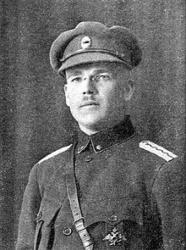
Paul Hausser
 Germany
Paul Hausser was a career officer who became one of the most senior commanders of the Waffen-SS and played a central role in building its officer training and military structure. His life moved from the Prussian and Reichswehr armies into the Nazi regime’s SS, where he commanded major formations during the Second World War. After the war, he became a leading advocate for former Waffen-SS members and worked to recast the organization’s history.
From the Prussian Army to the Reichswehr
Hausser was born in Brandenburg an der Havel on 7 October 1880, the son of a Prussian officer. He trained in the cadet corps and at the Prussian War Academy, entered the army in 1899, and served in staff and command roles during the First World War on both the Western and Eastern Fronts. He remained in the postwar Reichswehr, rising to the rank of lieutenant general before retiring in 1932.
His military career resumed under Nazi rule. After joining the nationalist veterans’ organization Stahlhelm, he entered the SA and then the SS in 1934. In 1937 he joined the Nazi Party. Heinrich Himmler tasked him with establishing an SS leadership school in Braunschweig. Hausser went on to oversee SS training schools and the SS-Verfügungstruppe, the armed formation that developed into the Waffen-SS. He was thus not simply a later battlefield commander: he helped organize and train the force from its early years.
Wartime Command
Hausser commanded the SS Division “Das Reich” during the invasions of France and Yugoslavia and later led the II SS Panzer Corps on the Eastern Front. He was wounded during the fighting near Moscow in 1941 and lost his right eye. In 1943 his corps fought at Kharkiv and Kursk; the following year it was sent to Normandy to oppose the Allied landings. He later commanded the German Seventh Army and Army Group G.
The Waffen-SS was the armed wing of the SS, an organization that the Nuremberg Tribunal declared criminal. Waffen-SS units took part in atrocities and mass violence across Europe. In 1943, for example, SS troops in northern Italy and Istria murdered civilians; historians document these crimes while noting that Hausser’s specific response to them is unknown. The record of his command therefore belongs within the wider history of a Nazi organization responsible for crimes, not as a stand-alone tale of battlefield leadership.
Captivity and Postwar Advocacy
Hausser was captured by U.S. forces in May 1945 and remained in custody until 1948. He was not indicted at the Nuremberg trial of major war criminals, but testified for the defense in 1946. He attempted to portray the Waffen-SS as a purely military organization, separate from Nazi crimes and the concentration camp system.
After release, he became a leading figure in HIAG, a veterans’ organization formed by former Waffen-SS members. Hausser used his public role and his books—including Waffen-SS in Action and Soldiers Like Any Other—to press for rehabilitation of the Waffen-SS and to promote the claim that its soldiers had fought like regular troops. That narrative minimized the organization’s ideological role and its connection to Nazi crimes, and has been rejected by historians.
Legacy
Hausser died in Ludwigsburg on 21 December 1972. His legacy has two inseparable parts: his influence on the creation and command of the Waffen-SS, and his postwar campaign to sanitize its record. A clear account of his life must include both his military positions and the crimes and political purposes of the organization he helped build.