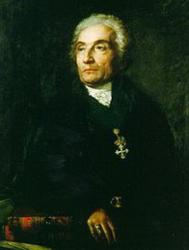
Paul-Henri Thiry d’Holbac
 France
- Biography of Paul-Henri Thiry d'Holbach
- Contributions to Revolutionary French Bourgeoisie
- Systematizer of French Materialist Thought
- Beliefs on the Laws of Nature
- Views on Human Society
Biography of Paul-Henri Thiry d'Holbach
Paul-Henri Thiry d'Holbach was a French philosopher, materialist, and atheist. He was born in 1723 and lived during the 18th century. D'Holbach played a significant role as an active contributor to the "Encyclopedia of Sciences, Arts, and Crafts," which was a project that aimed to disseminate knowledge during the Enlightenment period.
Contributions to Revolutionary French Bourgeoisie
D'Holbach was one of the intellectuals who shaped the revolutionary French bourgeoisie in the 18th century. He provided theoretical justification for the replacement of feudal orders with a new "Natural" and "Rational" social structure, which ultimately led to the establishment of a bourgeois society.
Systematizer of French Materialist Thought
D'Holbach was the foremost systematizer of the worldview of French materialists during the 18th century. He asserted the primacy and indestructibility of the material world, nature, which existed independently of human consciousness and was infinite in time and space.
According to D'Holbach, matter is the sum of all existing bodies, and its simplest, elementary particles are immutable and indivisible atoms. These atoms possess basic properties such as extension, weight, figure, impenetrability, and motion. The philosopher reduced all forms of motion to mechanical displacement.
D'Holbach denied the universal animacy of matter, believing that sensitivity was only inherent in specific forms of organized matter. In his main work, "The System of Nature," he consolidated the knowledge of contemporary natural sciences, earning it the nickname "The Bible of Materialism" in the 18th century.
Beliefs on the Laws of Nature
D'Holbach acknowledged the existence of objective laws governing the material world, asserting that these laws were constantly and unbreakably linked to their actions. He believed that humans were part of nature and were thus subject to its laws.
Advocating for the knowability of the material world, D'Holbach considered sensation to be the only source of knowledge. He believed that knowledge was a reflection of reality, and both sensation and concept were considered as images of objects.
Based on abstract concepts of human nature, D'Holbach reduced social phenomena to individual experiences and sought to explain social phenomena through the laws of nature.
Views on Human Society
According to D'Holbach, the development of human society was the result of governmental activities, exceptional individuals, enlightenment, and other factors. He regarded self-interest and personal benefit as the fundamental motivations behind human behavior, considering self-love and the pursuit of personal interests as the most significant characteristics of human nature.
However, D'Holbach rejected extreme selfishness and defended the idea of combining individual and communal interests. He recognized the formative role of the social environment in shaping individual personalities.