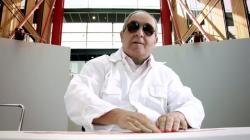
Pavel Zaltsman
- Early Life and Family Background
- Artistic Education and Influences
- Cinema and Wartime
- Post-War Career in Kazakhstan
- Recognition and Legacy
Early Life and Family Background
Pavel Zaltsman, a Soviet artist, graphic designer, and writer, was born in Kishinev, Moldova, on an unknown date. His father, Yakov, was a colonel in the tsarist army, while his mother, Maria, was of Jewish descent. Zaltsman was the youngest of three children, and his family later relocated to Odessa before settling in Leningrad in 1925.
Artistic Education and Influences
Zaltsman began his artistic journey as an illustrator for magazines in Leningrad. In 1929, he encountered Pavel Filonov, a renowned artist, and became a devout follower of his analytical art movement. He joined the "Masters of Analytical Art" group and the Leningrad branch of the Union of Artists of the USSR but later ceased his membership after the war.
Cinema and Wartime
From 1931 onwards, Zaltsman worked as an art director for the film studio Lenfilm, contributing to several notable films. He participated in film expeditions across the Soviet Union, including the Urals, the Caucasus, and Central Asia. During World War II, he designed camouflage schemes for the defense of Leningrad and was evacuated to Alma-Ata, Kazakhstan, in 1942.
Post-War Career in Kazakhstan
In Alma-Ata, Zaltsman worked for the Central United Film Studio of the country. After the war, he remained with the Kazakhfilm studio as a chief artist from 1955 to 1985. He played a significant role in films by Shaken Aimanov, Efim Aron, and Pavel Bogolyubov. Additionally, he taught art history in various institutions in Alma-Ata.
Recognition and Legacy
Pavel Zaltsman was a respected artist, earning the title of Honored Artist of the Kazakh SSR in 1962. His work often explored themes of humanity, nature, and the relationship between art and life. Zaltsman's legacy continues to inspire artists and scholars alike, solidifying his place as a notable figure in Soviet and Central Asian art.