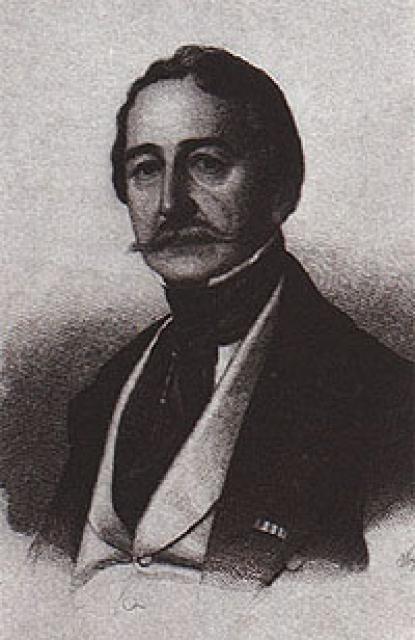
Peter von Hess
 Germany
Biography of Peter von Hess
Peter von Hess was a Bavarian court painter and a member of the Academies of Art in Munich, Berlin, Vienna, and St. Petersburg. He was born as the eldest son of Karl Ernst Christoph Hess, a Bavarian court engraver, from whom he received his first lessons in engraving. In 1806, he entered the Academy of Fine Arts in Munich, initially focusing on landscapes. Under the influence of A. Adam, he participated in military campaigns against the French from 1813 to 1815 (serving with the headquarters of Field Marshal K. Wrede) and captured many war scenes. The result of these campaigns was a large canvas titled "The Battle of Bar-sur-Aube" (1817). He later created a series of genre scenes from the military life of the 1812-1814 era, including "Skirmish between French Dragoons and Austrian Hussars," "Don Cossacks with Captured French Peasants," "The Crossing of the Kirghiz and Cossacks over the Rhine" (all in 1819), "Marauding Cossacks," "Defense of the Bridge at Hanau by General K. Pappenheim" (both in 1820), "Bivouac of Austrian Troops" (1823), "Austrian Uhlans Attacking a French Wagon" (1829), and others. In 1831, he accompanied King Otto to Greece and depicted his arrival in Navplion and triumphant entry into Athens (both paintings are now in the Munich "Neue Pinakothek"). In addition to these, he produced 39 paintings in collaboration with Nielsen, representing the main episodes of the Greek struggle for independence, which were displayed in the arcades of the Munich Hofgarten. In 1839, upon the invitation of Emperor Nicholas I, he visited Russia and received a commission to paint a series of pictures depicting the most important battles of 1812 for the Winter Palace. Together with the uniform expert General L. I. Keil, he made a trip to the battle sites of 1812, making numerous sketches (now preserved in Munich). He was a witness to the jubilee celebrations in 1839 at the Borodino Field. From 1840 to 1857, he created 12 paintings, of which 10 have been preserved. In addition to this commission, Hess completed large canvases, including "The Battle of Leipzig" (1854) and "The Battle of Austerlitz" (1860). His enormous, vibrant, and intricately detailed paintings were highly praised by his contemporaries but faced criticism from later art critics.




