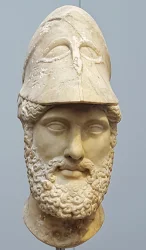
Petronius Maximus
Petronius Maximus was a powerful Roman senator whose brief reign coincided with the Western Roman Empire’s rapid political unravelling. Before becoming emperor in 455, he had held major offices and twice served as consul. His sudden rise followed the assassination of Valentinian III, and his rule collapsed less than three months later, just as the Vandals were preparing to attack Rome.
A senator’s career
Maximus was born around 397 into a prominent Roman family, though little is known about his early life or relatives. He entered public service in the early fifth century and advanced through a series of senior administrative posts. He served as prefect of Rome and prefect of the praetorian prefecture of Italy, offices that put him at the center of imperial government.
In 433 and again in 443, Maximus held the consulship, one of the most prestigious honors in the Roman world. He was also named patrician, the highest rank in the imperial civil hierarchy. His career placed him among the most influential members of the Western Empire’s senatorial elite.
By this time, however, the emperor’s authority was under severe strain. Military commanders and their forces held growing influence, while the empire faced pressure from outside powers and instability within the court. Maximus’s political success depended on this fragile balance.
The path to the throne
In 454, the powerful general Flavius Aëtius was assassinated by Emperor Valentinian III. The following year, Valentinian himself was killed by soldiers associated with Aëtius. Ancient accounts link Maximus to the political intrigue surrounding both deaths, but the details—especially stories about his personal revenge against Valentinian—are difficult to verify and may reflect later court gossip.
With the emperor dead and no clear successor, Maximus secured the support needed to take power. He became emperor on March 17, 455. His short reign began in a climate of uncertainty, as he sought to strengthen his position among the army, the Senate, and the imperial court.
To tie himself to the previous dynasty, Maximus married Licinia Eudoxia, Valentinian’s widow. Ancient writers say the marriage was forced, though the surviving accounts were shaped by the politics and hostility of the time. He also elevated his son Palladius to caesar and arranged his marriage to Eudocia, one of Eudoxia’s daughters. These alliances were meant to bolster the new emperor’s legitimacy, but they did little to secure broad support.
The Vandals and the fall of Rome
The Vandal king Gaiseric had long-standing claims and grievances involving the Roman court, and in 455 he prepared a major expedition against Italy. Later accounts say Eudoxia appealed to Gaiseric after Valentinian’s murder and her forced marriage, but historians cannot establish that this was the cause of the invasion. The Vandals’ intervention also reflected wider disputes over treaties, succession, and imperial politics.
As the Vandal fleet approached Rome in late May, Maximus attempted to leave the city. Panic spread among the population and army. He was killed during the disorder on May 31, 455; one account names a Roman soldier as his killer. The Vandals entered Rome shortly afterward and carried out a two-week sack.
Maximus had ruled for around two and a half months. His sudden death left the Western Empire without an effective leader at a moment of crisis, and a new emperor, Avitus, was soon proclaimed in Gaul.
Legacy
Petronius Maximus is one of the short-lived emperors of the West whose reign is known mainly through scattered and often conflicting accounts. His rapid ascent reflected his long experience in government, while his inability to secure lasting support revealed the weakness of the imperial system in 455.
Later writers sometimes portrayed him as a schemer whose personal ambitions helped bring about the sack of Rome. The evidence is less conclusive: the Vandals had independent reasons to intervene, and the details of his final days remain disputed. His story is best understood as part of a broader crisis in which court politics, military power, and external pressure converged on a city already struggling to defend its empire.