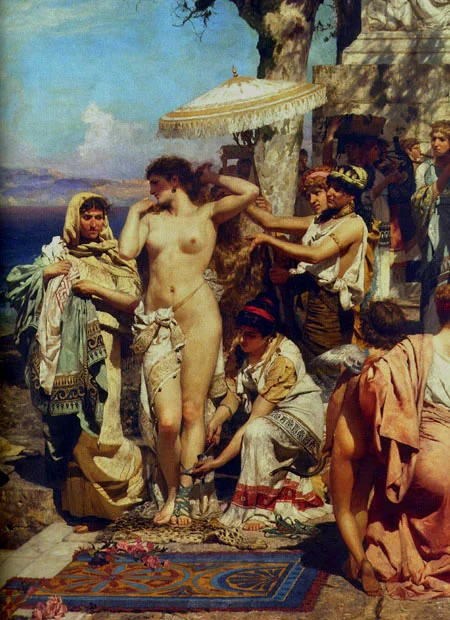
Phryne
Phryne was a celebrated Greek courtesan, or hetaira, who lived in the fourth century BCE and was associated with Athens and her native Thespiae in Boeotia. She became famous in antiquity for her wealth, beauty and connections with leading artists and public figures. Her life is difficult to reconstruct: most surviving stories were written long after her death, and many details may have been reshaped into legend.
Life in Athens
Ancient sources identify Phryne as a woman from Thespiae who worked as a hetaira in Athens. Unlike ordinary prostitution, the role of a hetaira could involve long-term relationships, education and participation in elite social circles. Writers described Phryne as exceptionally wealthy and influential, but their accounts reflect the fascination and stereotypes through which male authors discussed women in her profession.
Some sources give her birth name as Mnesarete, though this detail, like much of her biography, comes from later writers and cannot be confirmed with certainty. Stories about her generosity and public displays became part of her reputation, including accounts of lavish offerings at religious sanctuaries.
Art and the image of Aphrodite
Phryne is closely linked in ancient literary tradition to the sculptor Praxiteles. Later writers said she was his lover and model, and that she inspired his famous statue of Aphrodite at Knidos, one of the earliest monumental representations of the goddess nude. The association helped turn Phryne into a lasting emblem of beauty in Greek art and literature, although the exact nature of her role as a model is uncertain.
She was also connected in later accounts to the painter Apelles and his image of Aphrodite rising from the sea. These anecdotes present her as a muse whose body and public persona shaped art, but they survive through later sources rather than contemporary documentation.
The impiety trial
Phryne’s most famous story is her trial for impiety in Athens. The orator Hyperides reportedly defended her, while the prosecution is associated in ancient accounts with Euthias. The surviving tradition says that Hyperides revealed her body to the jurors as a final plea, and that the sight persuaded them to acquit her.
The dramatic scene is not securely established as fact. Accounts vary, and the best-known versions were written centuries after the trial. Scholars note that early references portray a different kind of appeal: one source says Phryne pleaded with the jurors individually and nearly lost the case. The episode’s evolving retelling shows how her image became a vehicle for stories about beauty, persuasion, sexuality and justice.
A life between history and legend
Phryne’s fame outlasted the world in which she lived. Artists and writers repeatedly reimagined her, especially in later European painting and sculpture, where the trial became a popular subject. These interpretations often reveal more about later ideals and fantasies than about the historical woman.
What can be said with confidence is limited but significant: she was a prominent fourth-century BCE hetaira whose name became attached to major works of art and to one of antiquity’s most enduring courtroom legends. The distance between the historical evidence and the spectacle of her later reputation is central to understanding her legacy.