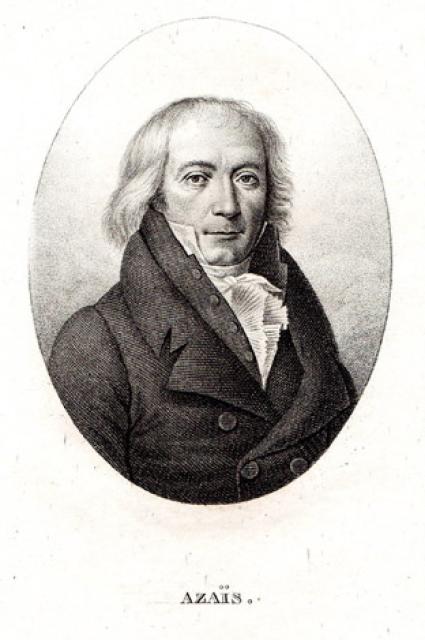
Pierre Hyacinthe Azais
 France
Biography of Pierre Hyacinthe Azais
Pierre Hyacinthe Azais was a French writer, journalist, and philosopher known for his broad range of interests, including politics, history, phrenology, mesmerism, psychology, and even artesian wells. He was born the son of a musician and initially worked as a teacher in Tarbes before becoming the secretary to the Bishop of Oleron, who unsuccessfully attempted to persuade Azais to enter the monastic life. Azais then retreated to the Seven Mountains and became an organist at a small Benedictine abbey (l’abbaye de Villemagne).
He initially supported the French Revolution, believing it would bring benefit to the country, but later became disillusioned with its methods. He wrote a critical pamphlet on the subject, which caused a stir and led to persecution by the temporary government. Sentenced to deportation on the 18th of Fructidor, Azais went into hiding in Tarbes, specifically in the hospital run by the Sisters of Mercy. He then retreated to the Pyrenees Mountains for several years.
The turbulent times of the revolution inspired Azais to embark on a serious and extensive study of the meaning of human destinies and the idea of universal compensation. At the age of forty, in 1806, he considered his work complete and decided to share the fruits of his thinking with the public. He arrived in Paris and gained widespread recognition for his work "Des compensations dans les destinées humaines" (On the Balancing of Human Destinies, 1809), where he depicted the joys and sufferings of human existence. He strove to demonstrate that the happiest person would eventually become the most miserable due to the unalterable law of retribution and equilibrium in the moral world.
Napoleon I highly valued Azais's work and appointed him as a professor at the Saint-Cyr Military Academy. In 1811, Azais became the inspector of the public library in Avignon, and from 1812, he held the same position in Nancy. However, he lost his position in 1815 due to an article he wrote fervently justifying Napoleon. Thanks to the support of some scholars and the famous Madame de Stael, he received a small pension from the government, allowing him to dedicate himself once again to his beloved pursuits of philosophy and writing. He established public philosophy lectures in his garden and was often compared to the ancient Greek thinkers by his contemporaries. Azais passed away in Paris on January 22, 1845.
Religious and metaphysical theory of Azais
Azais defined the force of universal expansion as the primary force and cause from which two actions stem: dilatation and compression. The oscillating interaction between these actions contributes to the equilibrium of the universe and serves as the starting point for all things and phenomena in the world and in human life, no matter how diverse they may seem.
According to Azais, the entire universe is nothing but the constant realization of a common plan of creation. Human beings enter into this plan as objects, and the fluctuation of their destinies is one of the principal results of the force maintaining the equilibrium of the universe. The supreme power leads the universe, and the most perfect and simplest order prevails in the realization of this great work. And as human beings, the objects of this grand construction, cannot contradict the general principle of justice through their creation and destiny, they are all equal in their fate. Humans are created for happiness. Absolute happiness consists of the complete satisfaction of all human needs. These needs are infinite in their diversity but can be categorized into two groups: those arising from internal human qualities (such as health, strength, beauty for the body; attachments for the heart; freedom and activity for the mind; desires for the imagination) and those arising from external aspects of human life (such as property and material possessions). If a person is to enjoy absolute happiness, they must be perfect. And if all individuals have an equal right to happiness, then they must be created with equal natural intellectual, moral, and physical abilities. However, if everyone were equal, they would not need each other, and life in society would be impossible. There would be no youth, old age, or the continuation of the human race. Thus, inequality is inherent to human existence, as it is the fundamental cause of the need for human society.
All primary abilities are part of each individual's essence, but their infinite differences depend on the various combinations and predominance of these abilities. Individuals and personalities often stand out due to subtle nuances, and their physical traits form a continuous gradation. Such a gradation of natural gifts would be an outrageous injustice if it existed alone. However, every aspect of human nature and all the conditions of their material life also form similar gradations. The opposite arrangement of gradations compensates for the damage to personal interests (misfortunes) for those who occupy the lower positions in the gradation. The combination and constant oscillation of gradations produce the overall equality of human destinies.
Although social inequality, particularly in countries where civilization has progressed, is largely influenced by external factors related to human institutions, which are secondary causes, this inequality is ultimately intended by the Creator of nature to be one of the rewards for inherent inequality. Human destinies are determined by two types of conditions: those that lie within the individual's organism and those that exist outside the individual. The former are advantages and disadvantages resulting from our bodily organization, age, etc. They are primary, and humans cannot change them. However, individuals can enhance the benefits they bring or mitigate the harm they cause. To achieve this, one must live with wisdom, according to Azais.
In conclusion, Azais states, "The true and final decision on a person's fate is only pronounced at the end of their earthly (primary) existence. To make an assessment, one must consider all the seemingly insignificant accidents and events because from this point onward, their destiny is to obtain eternal satisfaction from eternal justice."