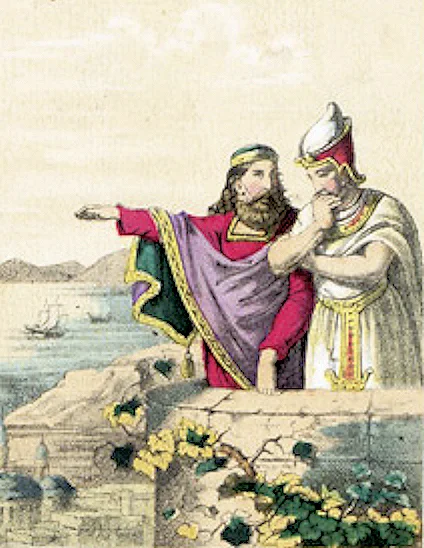
Polycrates
Polycrates ruled the Aegean island of Samos as a tyrant from about 538 to 522 BCE. Under his leadership, Samos became a formidable naval power and a prosperous center of Greek culture. His reign is known through the historian Herodotus, who describes both the island’s ambitious public works and the ruler’s dramatic downfall. Herodotus also preserved the famous tale of a ring cast into the sea and unexpectedly returned, a story that made Polycrates a lasting symbol of extraordinary good fortune.
Rise to power on Samos
Polycrates was the son of Aeaces and came to power with the help of his brothers, Pantagnotus and Syloson. He soon became sole ruler. The surviving sources provide only a partial account of his early career, but they portray him as an energetic leader who built up Samos’s military and maritime strength.
His rule was supported by a powerful fleet, which allowed him to project influence across the Aegean. He maintained relationships with major regional powers, including Egypt, whose king Amasis was initially his ally. Samos prospered as Polycrates expanded his authority and attracted wealth to the island. His reign also became associated with major building projects: a great temple to Hera, a harbor mole, and a tunnelled aqueduct that brought water to the city. These works demonstrated the resources and technical ambition of his government.
The ring and the fall of a tyrant
Herodotus tells a story in which Amasis, worried that Polycrates enjoyed unbroken success, advised him to sacrifice his most precious possession so that misfortune would balance his good fortune. Polycrates threw a treasured signet ring into the sea. Days later, a fisherman caught a large fish, and the ring was found inside it. Amasis interpreted the miraculous return as a sign that Polycrates’ luck was too powerful to escape a reckoning and ended their alliance.
The story may be shaped by legend and moral reflection, but it became inseparable from Polycrates’ memory. His actual political position grew increasingly precarious as he maneuvered between Greek and Persian powers. Around 522 BCE, the Persian governor Oroetes lured him to the mainland with promises of wealth and a political alliance. There Polycrates was seized and killed, reportedly crucified. His death ended his rule, though Samos remained contested by rival claimants and Persian interests.
Legacy
Polycrates’s reign left a mark on both the landscape and the imagination. The engineering and religious monuments associated with his government reflected the strength of archaic Samos, while his fleet made him one of the most influential Greek rulers of his era. Herodotus’ account preserves his ambition and the complex international politics of the eastern Aegean.
The ring story ensured that Polycrates became more than a historical ruler. In later literature and art, it served as a meditation on fortune, excess, and the belief that extraordinary prosperity could not last. Behind the legend was a ruler whose naval power and building program made Samos a major force, and whose violent end revealed the dangers faced by a small island state caught between competing empires.




