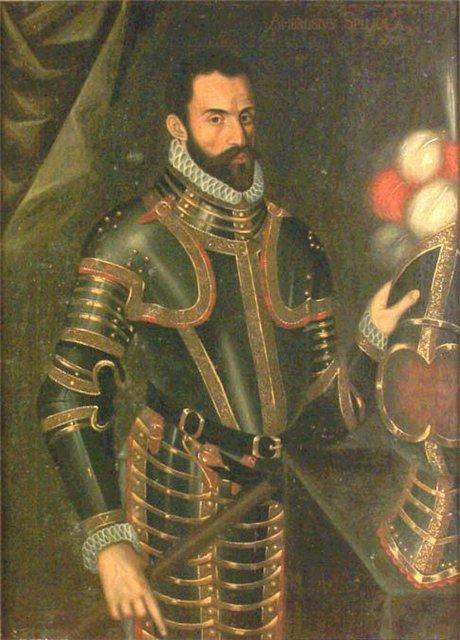
Pontus De la Gardie
 Sweden
- Peder Pontus De la Gardie
- Religious Upheaval and Military Yearnings
- Early Campaigns
- Campaigns in Scotland and Northern Europe
- Service in the Northern Seven Years' War
- Swedish Service and Military Victories
- Tragic Demise
- Legacy
Peder Pontus De la Gardie
Early LifePeder Pontus De la Gardie (born c. 1520) hailed from La Gardie, near Carcassonne, France. His father, Jacques Decouprie, was a member of an ancient French family. In 1511, he married Catherine de Saint-Colomb, who bore him three children, including Peder Pontus.
Religious Upheaval and Military Yearnings
De la Gardie's parents intended for their son to enter the priesthood, and so he was enrolled in the Abbey de Montolieu. However, his lively spirit and aversion to monastic life led him to flee the abbey and pursue a military career.
Early Campaigns
In 1551, De la Gardie embarked on his first campaign in Piedmont under the command of Marshal De Brissac. He distinguished himself in the Italian Wars, but upon their cessation in 1552, he returned to France.
Campaigns in Scotland and Northern Europe
In 1556, De la Gardie joined the French forces sent to support the regency of Mary Stuart in Scotland. There, he participated in the civil war between Catholics and Protestants.
Service in the Northern Seven Years' War
France's waning military expansionism prompted De la Gardie to seek employment in Denmark, which was at war with Sweden. In the bloody Northern Seven Years' War, he proved his worth and rose to command mercenaries. However, in 1565, he was wounded and captured by Swedish troops during the siege of Varberg.
Swedish Service and Military Victories
De la Gardie's capture marked the beginning of his illustrious career in Swedish service. He aided in the overthrow of King Erik XIV by Duke Johan, who became King Johan III. De la Gardie's military acumen and diplomatic skills earned him favor with the new monarch.
In the 1580s, De la Gardie led Swedish forces to victory, seizing the Karelian district, Estonia, and parts of Ingria, including the strategically important port of Narva. This resulted in the Treaty of Plussa, which confirmed these territorial gains for Sweden.
Tragic Demise
On November 5, 1585, tragedy struck as De la Gardie's boat capsized on the Narva River. Laden with heavy armor, he drowned alongside eighteen of his companions.
Legacy
De la Gardie's death was met with relief in Moscow, where he was considered a formidable adversary. He was interred in the Dome Cathedral in Reval (now Tallinn), beside his wife, who had died in childbirth in 1583.
The Flemish sculptor Arant Passer crafted De la Gardie's monument, a masterpiece of Renaissance art that depicts the couple in stone, along with scenes of his siege of Narva. His legacy as a skilled military commander and diplomat endured, and his descendants founded the Delagardi noble family in Sweden.





