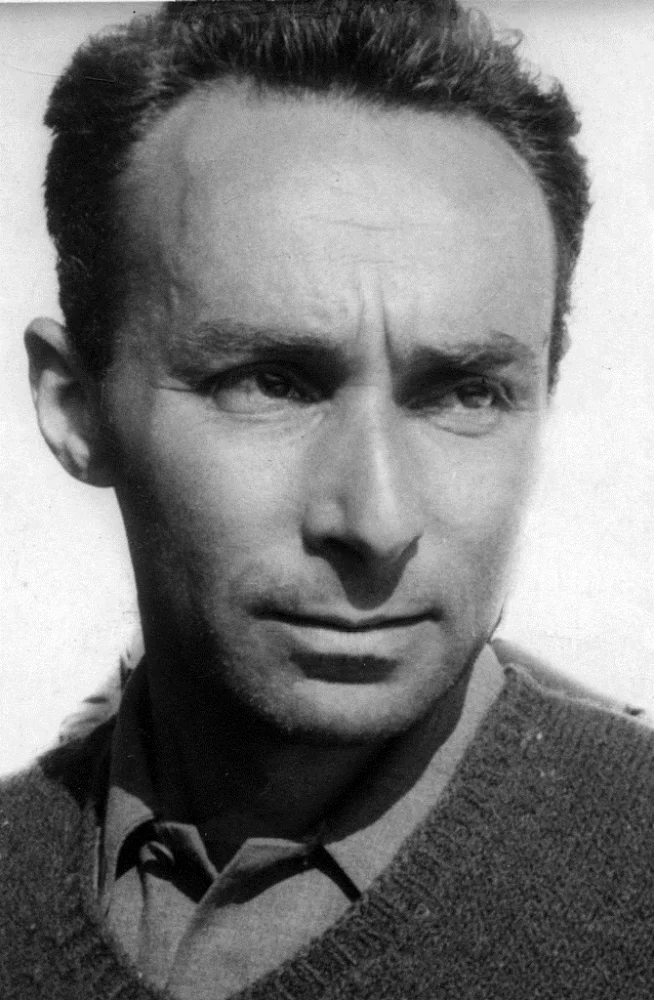
Primo Levi
Early life and education
Primo Levi was born in Turin on 31 July 1919 into an Italian Jewish family. Curious about science and the natural world, he enrolled at the University of Turin to study chemistry. Italy’s Fascist racial laws made university life increasingly hostile to Jewish students, but Levi was allowed to complete his studies and graduated with honors in 1941. His training would shape not only his working life but also the exact, observant style of his writing.
After Italy’s armistice with the Allies in 1943, Levi joined a small anti-Fascist partisan group. He was arrested in December and, identifying himself as Jewish, was first confined at Fossoli. In February 1944, German authorities deported him and hundreds of other prisoners to Auschwitz.
Auschwitz and return
Levi was sent to the Monowitz labor camp, where prisoners worked for the Buna synthetic-rubber plant. His chemistry skills eventually helped him obtain work in a laboratory, a circumstance that improved his chances of surviving the camp. He was also seriously ill when the SS evacuated many prisoners ahead of the Soviet advance in January 1945. Left behind with other sick inmates, he was liberated by Soviet forces.
His return to Italy was a long journey across Eastern Europe. He reached Turin in October 1945 and began turning his memories into a clear, unsparing account. First published in 1947, *If This Is a Man*—issued in the United States as *Survival in Auschwitz*—examines camp life and the pressures that tested human dignity. The book initially attracted little notice, but later became one of the best-known works of Holocaust testimony.
Chemistry and literature
Levi resumed his career as a chemist, eventually becoming a manager at SIVA, a paint and varnish company near Turin. He continued writing alongside his industrial work. *The Truce* (1963) recounts the winding journey home after liberation, while *The Periodic Table* (1975) brings chemistry, memory, and storytelling together through a sequence of linked episodes. Among his later works was *The Drowned and the Saved* (1986), a searching reflection on memory, responsibility, and life in the camps.
Levi’s prose is admired for its lucidity, precision, and moral seriousness. He died in Turin on 11 April 1987. His books remain central to discussions of the Holocaust and continue to reach readers through translations around the world.