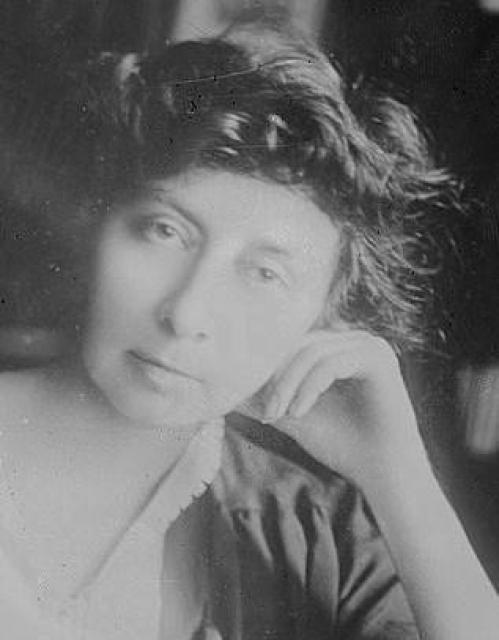
Rachel Crothers
 USA
- Growing up in Bloomington
- A playwright who directed her own work
- Public service and private life
- Legacy
Rachel Crothers helped change who could shape a Broadway production. Across a career that stretched from the early 1900s into the 1940s, she wrote plays about women’s choices and social expectations, then frequently took charge of casting, producing and directing them herself. Her ability to move between the page and the rehearsal room made her one of the most successful women in the commercial American theatre of her generation.
Growing up in Bloomington
Crothers was born in Bloomington, Illinois, on 12 December 1878. Her mother, Mary Louise Crothers, was a physician at a time when women faced steep barriers in medicine; local histories describe her as one of the first women doctors in the region. That example of a woman building a professional life in a male-dominated field would resonate with the questions Crothers later put onstage.
The youngest child in a large family, Rachel developed an early interest in acting and storytelling. She attended Illinois State Normal University, now Illinois State University, graduating in 1892, and studied dramatic art in Boston and New York. Back in Bloomington, she taught elocution and performed, but the pull of the professional stage remained strong. She moved to New York in the 1890s, initially pursuing acting and taking theatre work while learning how productions were made.
A playwright who directed her own work
Crothers began with short plays and early writing efforts, but her Broadway breakthrough came with The Three of Us in 1906. The play’s success opened a lasting place for her in New York theatre. Over the next three decades, she wrote a steady stream of dramas and comedies, with nearly thirty of her works reaching Broadway between 1906 and 1937.
Crothers did not leave the staging to others. She cast and directed most of her plays, and often produced them as well, an unusual degree of creative control for a woman in the era’s theatre industry. The combination required her to persuade actors, producers and audiences that a woman writer could also lead the room. She built that authority through well-constructed scripts and a reputation for exacting standards, rather than through a single hit.
Many of her plays turned contemporary debates into lively domestic drama. A Man’s World (1910) examined the sexual double standard and the different judgments society applied to men and women. He and She (1920) explored conflicts around marriage, artistic work and gender roles. Later comedies such as Let Us Be Gay and When Ladies Meet (both 1929) brought romantic and social maneuvering to the stage with a light touch, while still asking what women were permitted to want for themselves.
The tone could shift sharply from satire to earnest social observation. Susan and God, first staged in 1937, follows a woman who returns from Europe newly devoted to a religious self-improvement movement and attempts to remake the people around her. The play’s humor comes from the gap between reforming zeal and ordinary human behavior. Hollywood adapted it in 1940, with Joan Crawford in the leading role; When Ladies Meet also became a film, starring Myrna Loy, Ann Harding and Robert Montgomery.
Public service and private life
Crothers’s work beyond Broadway included organizing relief for theatre workers. During the First World War she helped establish Stage Women’s War Relief, which mobilized women in the theatre community to support wartime efforts. In 1940 she helped organize the American Theatre Wing, which operated the Stage Door Canteens where service members could meet performers and enjoy hospitality during the Second World War. She served as the organization’s executive director until 1950.
Crothers kept her personal life largely outside the spotlight. She never married or had children, according to biographical accounts, while writing with unusual range about marriage, parenthood and the compromises women faced in both family and professional life. Her plays were not simply arguments dressed as drama: they put competing desires into conversation and let audiences see the friction between social rules and individual ambition.
Legacy
By the end of the 1930s, Crothers had built a career that many playwrights could only imagine: a long run of commercially successful Broadway productions, direct involvement in how her work reached the stage, and recognition as a leading woman dramatist. She continued to be active in theatre and in service work after her most prolific writing years. Crothers died at her home in Danbury, Connecticut, on 5 July 1958.
Her name is less familiar to many theatregoers now than it was at the height of her career, but the scope of her achievement remains striking. Crothers wrote about changing roles for women while also expanding the roles available to women behind the scenes. Her career offered a practical demonstration of the independence her heroines sought: she wrote the play, shaped the production and took responsibility for bringing it before an audience.


