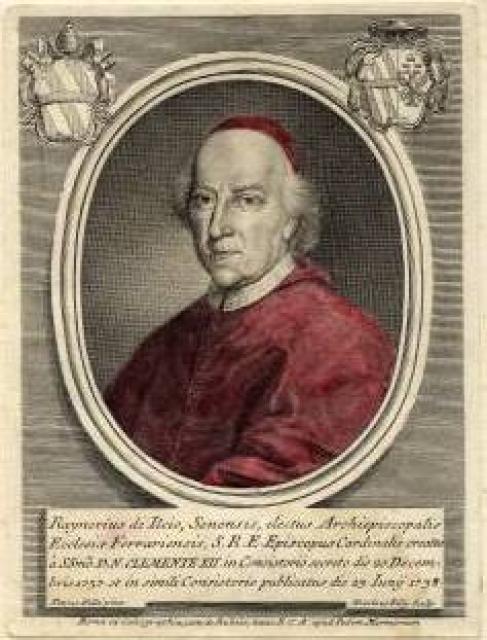
Rainiero D'Elci
 Italy
- Tuscan roots and education
- Service in the Curia and abroad
- Cardinal and senior church leader
- Final years and legacy
Raniero d’Elci spent much of his life serving the Catholic Church as a diplomat, administrator and senior cardinal. Born into a prominent Tuscan family, he moved from legal studies into the Roman Curia and eventually became dean of the College of Cardinals. His long career crossed the worlds of church government and European politics, as papal representatives worked to protect the interests of Rome amid shifting alliances and dynastic conflicts.
Tuscan roots and education
D’Elci was born in Florence on March 7, 1670, into the family of the marquises of Monticiano and counts of d’Elci. His parents were Filippo d’Elci and Francesca Torrigiani. The family had strong church connections: his uncles included the cardinal Scipione d’Elci and Scipione d’Elci, archbishop of Pisa.
He studied at the Tolomei College in Siena and earned a degree in both civil and canon law at the University of Siena in 1695. For a time, he practiced as a lawyer. He was ordained a priest on December 21, 1699, and soon entered papal service. In 1700 Pope Innocent XII appointed him a domestic prelate and a referendary of the courts of the Apostolic Signatura, placing him among the officials who advised on and administered church justice.
Service in the Curia and abroad
Under Pope Clement XI, d’Elci undertook administrative and diplomatic assignments in the Papal States. He served as vice-legate in Romagna in 1701, during the wider European tension surrounding the Spanish succession. Later he held responsibilities in several papal territories and offices, including service as inquisitor in Malta from 1711 to 1716. These posts gave him experience in both local governance and the negotiations required to represent papal authority.
In 1730 he was named titular archbishop of Rhodes. The following year, he became apostolic nuncio to France, the pope’s principal diplomatic representative at the French court. He served there through 1738, navigating a period of European conflict and political maneuvering. His appointment placed him at the intersection of church diplomacy and the competing ambitions of the major Catholic powers.
Cardinal and senior church leader
Pope Clement XII made d’Elci a cardinal in 1737, initially reserving the appointment in secret. It was formally announced the next year. In 1738 he became archbishop of Ferrara and later served as papal legate there. He continued to rise through the Church’s senior ranks, becoming bishop of Sabina in 1747 and then bishop of Porto and Santa Rufina in 1753.
In 1755 d’Elci became dean of the College of Cardinals, a position that placed him at the head of the cardinalate. As dean, he also took the traditional bishopric of Ostia and Velletri in 1756. His advanced age did not remove him from the center of church affairs: he presided over the papal conclave of 1758, which elected Pope Clement XIII. Reports from the conclave noted that he himself received votes.
Final years and legacy
D’Elci died in Rome on June 22, 1761, aged 91. He was buried at Santa Sabina, the church associated with his cardinal-priest title. He had served through the pontificates of several popes, shifting from legal and administrative work to high-level diplomacy and finally to leadership within the College of Cardinals.
His career illustrates the breadth of service expected of a senior churchman in eighteenth-century Europe. D’Elci was not known primarily as a theologian or public preacher; his influence came through the offices he held, the diplomacy he conducted and his place in the succession of the Church’s leadership.