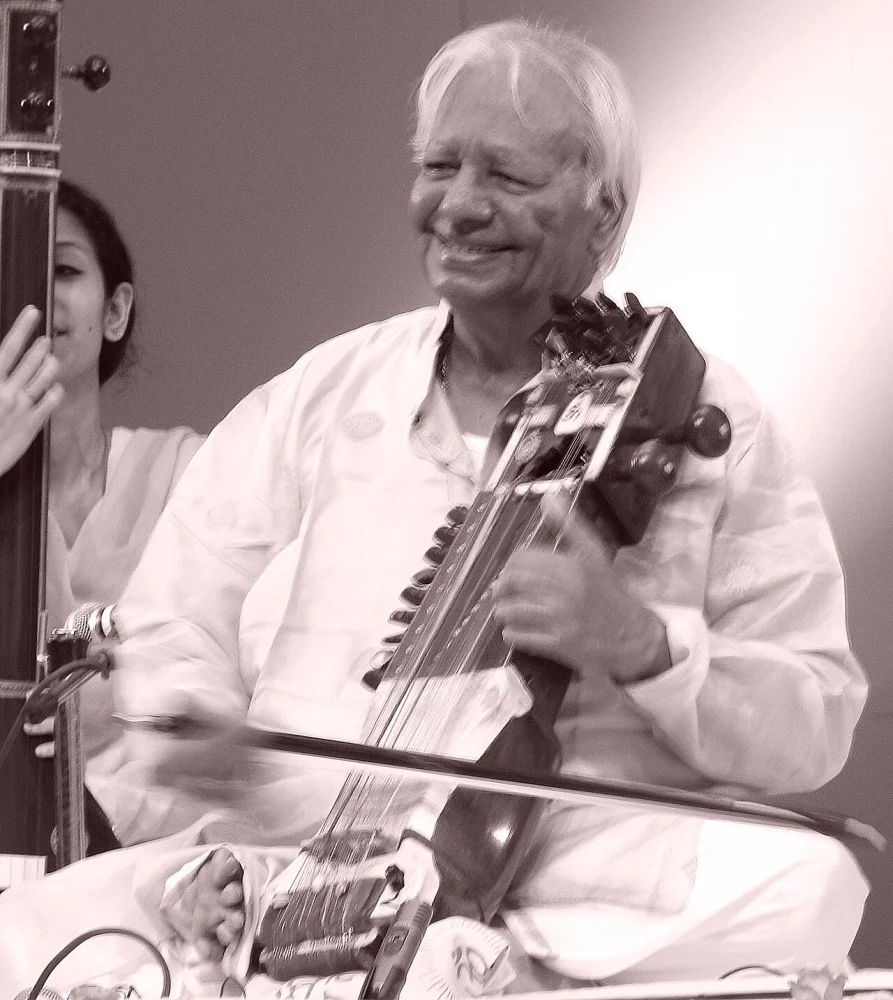
Ram Narayan
Ram Narayan was born on December 25, 1927, in the Udaipur region of Rajasthan, then part of British India. He grew up in a family of musicians and began learning the sarangi, a bowed instrument known for its rich, voice-like sound. At the time, it was most often heard accompanying singers. Narayan devoted his life to showing that it could command the concert stage on its own.
Learning the Sarangi
His father, Nathuji Biawat, was a musician who played the dilruba, and he gave his son his first musical training. Narayan continued his studies with several teachers in Rajasthan before traveling to Lahore to learn from the influential vocalist and teacher Abdul Wahid Khan. The training in the Kirana tradition helped shape the expansive, vocal quality of his performances.
In 1944, Narayan joined All India Radio in Lahore as a sarangi accompanist. After the 1947 Partition, he moved to Delhi and continued working for the broadcaster. He accompanied prominent Hindustani vocalists, including Omkarnath Thakur, Bade Ghulam Ali Khan, and Hirabai Barodekar. He also played for film composers in Bombay, contributing to popular Hindi cinema while building his classical career.
From Accompaniment to Solo Stardom
Narayan was dissatisfied with the sarangi’s status as a supporting instrument. In 1956 he began appearing as a solo concert artist, often accompanied by his brother, tabla player Chatur Lal. He gradually reduced his work as an accompanist, insisting that the sarangi deserved the same attention as the sitar or violin. International tours in the 1960s introduced his music to wider audiences and helped change perceptions of the instrument.
His performances drew on the Hindustani raga tradition, with long melodic lines, expressive slides, and a distinctive ability to imitate the nuances of the human voice. He also refined the instrument and bow for solo performance, broadening its range and projection. Critics and fellow musicians praised the many colors he could draw from the sarangi, which became central to his reputation.
A Lasting Musical Legacy
Narayan received the Sangeet Natak Akademi Award and some of India’s highest civilian honors: the Padma Shri in 1976, the Padma Bhushan in 1991, and the Padma Vibhushan in 2005. His daughter Aruna Narayan Kalle followed him as a sarangi player, extending the instrument’s presence across generations.
He died in Mumbai on November 9, 2024, at the age of 96. Ram Narayan’s importance lies in both his artistry and his persistence. By taking an instrument long confined to accompaniment and making it a compelling solo voice, he opened new possibilities for the sarangi and helped bring Hindustani classical music to listeners around the world.