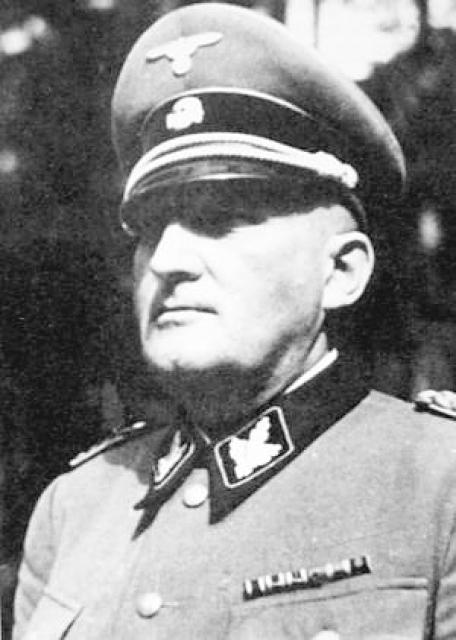
Richard Glucks
 Germany
Biography of Richard Glücks
Richard Glücks was a lieutenant general in the SS and the head of the Nazi concentration camp system from March 3, 1943, to May 8, 1943. He was born in 1889 in Odenkirchen, near Mönchengladbach, Germany. After graduating from high school in Düsseldorf, he worked for his father's fire insurance agency. In 1909, Glücks volunteered for one year in the army and served in the artillery. In 1913, he traveled to England and then moved to Argentina, where he worked as a trader in an import-export company.
When World War I started in January 1915, Glücks returned to Germany on a Norwegian ship using false documents as a sailor. After his return, he rejoined the army and eventually became the commander of a motorized artillery unit. He was awarded the Iron Cross First and Second Class for his service during the war. After the war, Glücks served as a liaison officer between German troops and the Military Commission of the Allies, ensuring compliance with the restrictions imposed on Germany by the Treaty of Versailles regarding armaments and the size of the German armed forces. He held this position until 1924 and was also a member of the Volunteer Corps in 1919.
In 1930, Glücks joined the Nazi Party (membership number 214,805), and in 1932, he joined the SS (membership number 58,706). On November 9, 1933, he was promoted to the rank of SS-Sturmführer. From September 6, 1933, to June 20, 1935, Glücks served in the SS Group "West" and rose to the rank of SS-Sturmbannführer. Later, he became the commander of the 77th SS Standarte in the Allgemeine SS and an SS-Obersturmbannführer. On April 1, 1936, Glücks became the chief of staff for Theodor Eicke and later the inspector of concentration camps. He initially held the rank of SS-Standartenführer and was later promoted to SS-Oberführer.
Following Eicke's appointment as the commander of the SS Division "Totenkopf" and his increased presence on the front lines, Glücks assumed more responsibility as the leader of Division D in the newly formed Main Economic and Administrative Office of the SS (Wirtschafts-Verwaltungshauptamt (WVHA)). On July 23, 1943, he was promoted to SS-Gruppenführer and Waffen-SS lieutenant general. The management group under his command oversaw all Nazi concentration camps, including the medical services responsible for conducting experiments on prisoners.
During the war, Glücks, constantly on the verge of a nervous breakdown, began to abuse alcohol and became an alcoholic. He spent most of his time in his headquarters in Oranienburg. When the Allied air force bombings destroyed the WVHA headquarters in Berlin, the WVHA leadership relocated to Northern Pomerania near the Baltic Sea on April 16, 1945. As the Soviet army advanced during the Berlin Offensive in late April, Glücks and his wife fled to Flensburg. It is known that he met with Heinrich Himmler there. After Germany's surrender, it is believed that Glücks took his own life by swallowing a cyanide ampule on May 10, 1945, at the naval base in Flensburg-Mürwik. Some historians claim that he was arrested by British forces on May 9, 1945, and his suicide occurred at a military hospital in Flensburg. Since there is no irrefutable evidence confirming Glücks' suicide, some historians speculate that he escaped. However, according to some sources, Glücks' death was officially confirmed, but subsequent exhumation of the body did not yield conclusive results.


