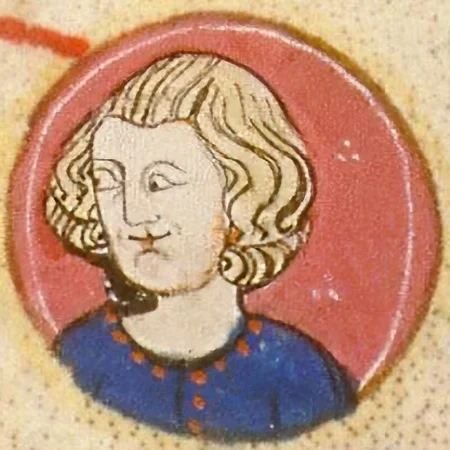
Robert
Robert of Clermont lived in the shadow of a royal family, but his marriage gave rise to one of Europe’s most enduring dynasties. A son of King Louis IX of France, he received the county of Clermont-en-Beauvaisis as an appanage. Through his wife, Beatrice of Burgundy, he also acquired a claim to the lordship of Bourbon. Their descendants became known as the House of Bourbon, later rulers of France and other European kingdoms.
A Royal Son
Robert was born in 1256, the youngest son of Louis IX and Margaret of Provence. His father, remembered as Saint Louis, ruled France during a period of expanding royal authority. Robert was granted the County of Clermont-en-Beauvaisis in 1269, giving him a territorial base and the title by which history usually remembers him.
In 1272 he married Beatrice, daughter and heiress of John of Burgundy and Agnes of Bourbon. Her inheritance connected Robert to Bourbonnais and Charolais, adding lands and influence to the Clermont appanage. The union was both a personal partnership and a consequential dynastic alliance: its legacy would eventually far exceed Robert’s own political career.
An Accident and a Quieter Role
A serious injury during a tournament in 1279 is said to have left Robert impaired for much of his later life. Medieval accounts describe the accident as a violent blow to the head. The details are difficult to reconstruct, but the injury helps explain why Robert played a more limited public role than many of his royal brothers.
He nevertheless remained a figure of standing in the kingdom, serving as a royal chamberlain and governing his lands. His wife’s inheritance and the family’s growing network of alliances ensured that the next generation would hold a stronger position. Their son Louis inherited the Bourbon lands and became the first Duke of Bourbon, formalizing the family’s rise.
The Bourbon Legacy
Robert died in 1317. By then, his family had become firmly established among the great noble houses of France. Generations later, the senior Capetian lines descended from his older brothers ended, and the Bourbon branch inherited the claim to the French throne. Henry IV became the first Bourbon king of France in 1589; Bourbon rulers later reigned in Spain and elsewhere.
Robert himself was not a conqueror or a king. His importance came from a combination of royal birth, territorial inheritance, and a marriage that joined the Clermont name to Bourbon lands. The dynasty that followed made his modest medieval title resonate through centuries of European history.