Robert Ettinger
 USA
USABiography of Robert Ettinger
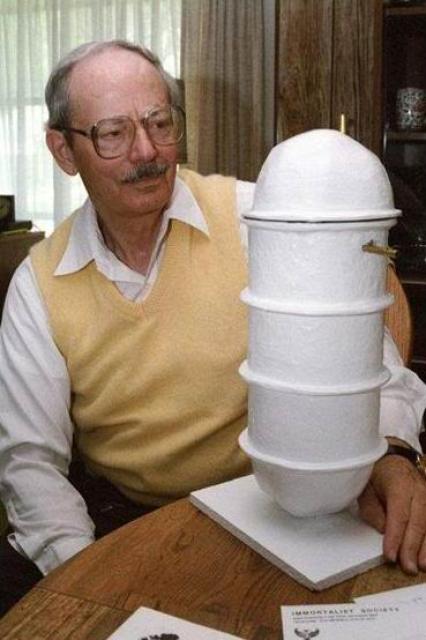
Robert Ettinger was an American scientist and the creator of cryonics. He earned the nickname "Father of Cryonics" due to the significant influence he had on popularizing cryonics through his book "The Prospect of Immortality" published in 1962. His ideas expressed in the book "Man into Superman" in 1972 also make him a pioneer of the concept of transhumanism.

Ettinger was born in Atlantic City, New Jersey, to Russian Jewish immigrant parents. During World War II, he served in an infantry regiment and was severely wounded in Germany, receiving the Purple Heart medal. After several years of recovery, he left the army and enrolled in Wayne State University, where he obtained master's degrees in both physics and mathematics. Ettinger taught at his alma mater and at Park Community College in Michigan for some time.

In his first marriage, Ettinger had two children, David and Shelley. David followed in his father's footsteps and gave his first interview about cryonics to journalists at the age of 12. He currently works at the Cryonics Institute and the Immortalist Society. However, Shelley does not share her father and brother's interests.

In 1962, Robert met Mae Junod, who quickly became one of his most active assistants. After the death of his first wife, Elaine, Ettinger remarried Mae Junod. They had a happy marriage until 2000 when Mae suffered a stroke. Robert had to freeze her body for future revival.

Ettinger developed an interest in eternal life and cryonics from a young age. He always believed that biologists would eventually discover the secret of eternal youth. However, as a teenager, he realized that this event might occur later than he hoped. In 1947, Ettinger learned about the work of French scientist Jean Rostand on cryopreservation, which inspired him to write a short story about cryonics as a form of time travel to the future. The story was published in March 1948, solidifying Ettinger's reputation as the founder of the idea of artificial freezing. He also pointed out that the criteria for death change over time, and someone who was considered hopeless yesterday could become a promising patient tomorrow.
In 1960, at the age of 42, Ettinger confirmed that he was increasingly concerned about death as he grew older. He sent his work on cryonics, summarizing his thoughts on the subject in a few pages, to nearly 200 prominent Americans listed in "Who's Who in America." Unfortunately, he failed to generate significant interest among the American public. Ettinger realized that attracting public attention would be much more challenging than he previously thought. He understood that even the most educated potential listeners were not capable of quickly comprehending that death often does not occur immediately and can often be prevented.
After publishing "The Prospect of Immortality," Ettinger expected a significant leap forward in cryonics research and believed that scientists and industrialists would become more actively involved in the field. Surprisingly, Evan Cooper's book "Immortality: Physically, Scientifically, Now" achieved much greater success. Cooper was less precise in scientific terms, but his work was more warmly received. Cooper founded the first cryonics group, the "Life Extension Society." Although Cooper left cryonics in 1969, his works laid the foundation for the movement and were successfully developed by Ettinger.
Cryonics development was slow until 1990, when Ettinger realized that the numerous barriers, mainly in people's minds, could gradually be overcome. Popularizing cryonics among the general public and funding new research in the field became Ettinger's main life goal. He pursued his passion with varying success until his death on July 23, 2011. Ettinger's body, like those of his two wives and his mother, was cryopreserved for future revival.