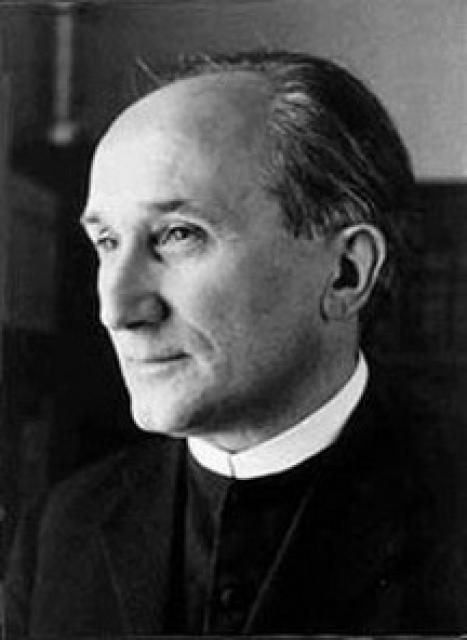
Romano Guardini
 Germany
Biography of Romano Guardini
Romano Guardini was a German philosopher and Catholic theologian of Italian descent. Born in Verona, Italy in 1885, his family relocated to Mainz, Germany in 1886. Guardini initially studied chemistry and economics before ultimately choosing theology as his field of study. He pursued his theological education at the University of Freiburg.
In 1910, Guardini was ordained as a priest and went on to defend his master's thesis on the theology of Bonaventure in 1915. He became a prominent leader in the Catholic youth movement and an influential figure in the religious and social sphere of his time. Guardini held the position of Privatdozent (lecturer) in Bonn from 1921 and became an ordinary professor of the philosophy of religion in Berlin in 1923.
Unfortunately, Guardini's career was interrupted by the Nazi regime in 1939 when he was stripped of his teaching position and academic title. However, after the end of World War II in 1945, he returned to the university and resumed teaching. He later taught at the University of Tübingen in 1946 and at the University of Munich in 1949 before retiring in 1962. Throughout his life, Guardini remained actively engaged in the life of the Church.
Guardini's philosophical works were greatly influenced by phenomenology and hermeneutics, drawing inspiration from thinkers such as Dilthey, Simmel, Husserl, and Scheler. He wrote extensively on philosophical anthropology and the philosophy of culture, often incorporating insights from the artistic creations of Dante, Hölderlin, Dostoevsky, and Rilke.
Among Guardini's most renowned books are "The Spirit of the Liturgy," "The Lord," and "The End of the Modern World," which have been widely translated and reprinted in multiple languages. His writings were highly esteemed by notable intellectuals such as Hannah Arendt and Flannery O'Connor. Guardini received numerous accolades for his contributions, including the Peace Prize of the German Book Trade in 1952 and the Erasmus Prize in 1962.




