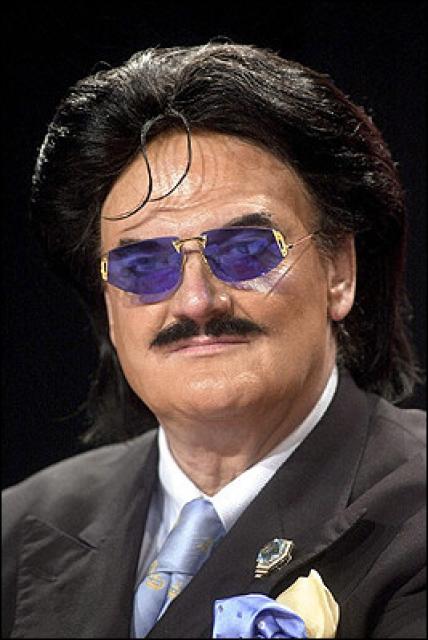
Rudolph Moshammer
 Germany
Rudolph Moshammer was a German fashion designer and Munich celebrity whose flamboyant personal style became as recognizable as his luxury menswear. His boutique on the city’s prestigious Maximilianstraße attracted wealthy clients, while his black wig, dramatic makeup and Yorkshire terrier, Daisy, made him a fixture of society pages and television.
Fashion and the Munich High Society
Born in Munich in 1940, Moshammer trained in retail and textiles before turning to design. In 1968, he and his mother, Else, opened the boutique Carnaval de Venise on Maximilianstraße. He built a business creating elegant men’s clothing in luxurious fabrics, including silk, cashmere and fur. The shop became a destination for Germany’s affluent and well-connected, and his clients included entertainers and public figures such as Arnold Schwarzenegger and tenor José Carreras.
Moshammer understood that his own image was part of the label. He appeared at balls, charity events and on talk shows in highly theatrical outfits, often with Daisy tucked under his arm and his mother beside him. Known affectionately as “Mosi,” he cultivated the persona of an eccentric dandy, transforming his public appearances into an extension of his fashion brand.
Public Life and Charity
Despite the high-society setting of his business, Moshammer also drew attention to homelessness. In 2000, he established the Licht für Obdachlose foundation to support people without housing in Munich. His concern was connected to his own account of family hardship in his youth. The cause became an important part of his public life and outlasted him through an organization that continued in his name.
Death and Legacy
Moshammer was found murdered at his home in Grünwald, near Munich, on January 14, 2005. A 25-year-old man confessed to the killing and was later sentenced to life imprisonment. The news shocked Germany, where Moshammer had become an instantly recognizable figure whose theatrical style and charity work drew attention well beyond the fashion world.
His legacy combines the craft of a successful menswear designer with an unusually vivid celebrity persona. The boutique, his devotion to his mother and dog, and his public support for homeless people all formed part of the image he carefully built. Years after his death, he remains associated with Munich’s fashion scene and with one of the most distinctive public characters in modern German popular culture.