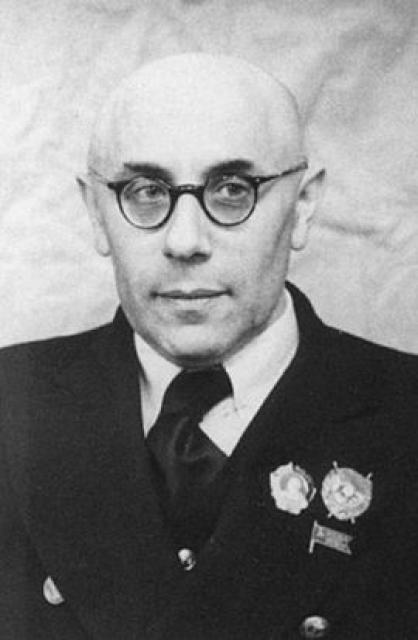
Semen Dukelskiy
- Birth and Early Life
- Military Service and Political Involvement
- Secret Police and Political Purges
- Leadership and Economic Management
- Return to Secret Police and Cinema Administration
- People's Commissar of the Navy and Later Career
Birth and Early Life
Peter Fedorovich Dukelskywas born into a civil servant's family in the Russian Empire. After receiving a secondary education, he worked as a typesetter in private printing shops from 1906 to 1908.
Military Service and Political Involvement
From 1915 onwards, Dukelsky served in the Imperial Russian Army as a rank-and-file musician. Following the February Revolution in 1917, he became actively involved in military affairs and joined the Bolshevik Party the same year. In 1918, he assisted in supplying the Finnish Red Guard, and from 1919 to 1920, he held positions in the People's Commissariat for Military Affairs, including as representative for the Council of Defense of Ukraine.
Secret Police and Political Purges
In 1919, Dukelsky took up the post of secretary of Central Management for Special Departments of the Southern and Southwestern Fronts. He continued to rise through the ranks of the secret police, becoming chief of the Secret and Political Department and head of the Anti-Banditry Department on the Southern Front in 1920.
From 1921 to 1922, Dukelsky chaired the Odessa Regional Cheka and was involved in disinformation campaigns abroad. He later headed the Transport Department of the OGPU (United State Political Administration) from 1922 to 1924.
Leadership and Economic Management
Dukelsky held various leadership positions within the Soviet economic system. He directed a food industry trust in Odessa, a factory in Kharkiv, and a coal mining trust from 1926 to 1930.
Return to Secret Police and Cinema Administration
From 1930 to 1934, Dukelsky was appointed Deputy Plenipotentiary Representative of the OGPU in the Central Black Earth Region. He also oversaw the prosecution of several Voronezh regional historians and personally oversaw the exiled poet Osip Mandelstam.
In early 1938, Dukelsky was appointed Chairman of the Committee on Cinematography under the Council of People's Commissars. He introduced significant reforms, including a system of fixed rates for creative workers in the film industry.
People's Commissar of the Navy and Later Career
Dukelsky served as People's Commissar of the Soviet Navy from 1939 to 1942. During this period, he played a crucial role in organizing the Soviet naval forces during World War II.
After the war, Dukelsky became Deputy Minister of Justice of the Russian SFSR. He held this position until 1948, when he retired. Dukelsky passed away in Moscow in 1952.