Sidonio Bernardino Cardoso da Silva Pais
 Portugal
- Sidónio Bernardino Cardoso da Silva Paes Biography
- Early Life and Education
- Academic and Political Career
- Ambassadorship and Presidency
- Downfall and Assassination
Sidónio Bernardino Cardoso da Silva Paes Biography
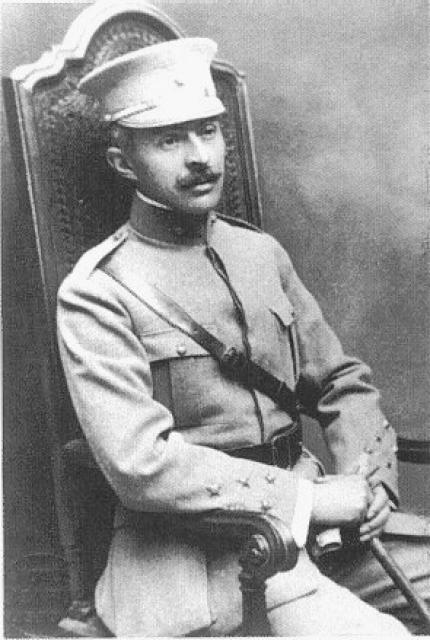
Sidónio Bernardino Cardoso da Silva Paes was a military and political figure in Portugal. He held various positions, including Minister of Finance, Ambassador of Portugal to Berlin, and President of the Portuguese Republic. As President, he had dictatorial powers and suspended and amended the Portuguese Constitution in 1911. Additionally, he was a professor at the University of Coimbra, where he taught differential and integral mathematics.
Early Life and Education
Sidónio Paes was born in Caminha, into the family of notary Alberto Sidónio Paes. He lived in Amarante with his wife Maria Dulce Prazeres Martins Bessa, with whom he had five children. He received his secondary education at a school in Viana do Castelo and then went on to study mathematics at the University of Coimbra. In 1888, he enrolled in the military academy, specializing in artillery. He excelled as a student and graduated with honors. In 1892, he was promoted to second lieutenant, followed by lieutenant in 1895, and captain in 1906.
Academic and Political Career
After completing the military academy, Paes joined the University of Coimbra, where he graduated in 1898. He became a proponent of republican ideals during his time at the university. As a respected mathematician, he was appointed as a professor of differential and integral calculus at the university. On October 23, 1910, he was appointed Vice-Rector. Following the proclamation of the Portuguese Republic in 1910, he became actively involved in politics. He briefly served as the Chairman of the Board of Directors of the Portuguese Railways and was elected as a deputy in the National Constituent Assembly. He played a role in the creation of the Portuguese Constitution in 1911. As a prominent member of the Portuguese Parliament, he was appointed Minister of Development in the government of João Chagas on August 24, 1911. After the fall of the João Chagas government, he remained in power and became Minister of Finance in the government of Augusto Vasconcelos Correia. He assumed this position on November 7, 1912, and held it until June 16, 1912.
Ambassadorship and Presidency
In August 1912, with the escalation of international tensions leading to the outbreak of World War I, Paes was appointed as Portugal's Ambassador to Berlin. He held this important diplomatic position throughout the critical period until March 9, 1916, when Germany declared war on Portugal after seizing Portuguese ships in Portuguese ports. Upon his return to Portugal, Paes joined the ranks of those opposing Portugal's participation in the Great War. As the leader of the opposition to the Democratic government, he led a military coup from December 5 to 8, 1917, which brought a military junta to power. On December 11, 1917, Paes assumed the presidency of Portugal and also held the positions of Minister of Defense and Minister of Foreign Affairs. He made significant changes to the 1911 Constitution, which he had helped write. His regime acquired dictatorial powers, and he became known as the "president-king." The new political system became known as the New Republic and served as a precursor to the subsequent dictatorship of António de Oliveira Salazar.
Downfall and Assassination
In an attempt to improve relations with the Roman Catholic Church, Paes signed amendments to the law on the separation of church and state on February 23, 1918. This move triggered a strong negative reaction from republicans who enjoyed the broad support of Catholics and rural populations. On March 11, 1918, in violation of the constitution, Paes issued a decree for direct presidential elections, leveraging his popularity among Catholics. On April 28, 1918, he was elected as President with an unprecedented result of 470,831 votes. However, he used this victory to suppress any opposition. The February and March 1918 decrees, which contradicted the existing constitution, became known as the 1918 Constitution. Afterward, a strict presidential republic regime was established.
In April 1918, Portugal's expeditionary forces suffered significant losses in the Battle of La Lys, and the Portuguese government was unable to provide the necessary reinforcements to maintain the combat readiness of the troops. The situation became so critical that even after the armistice, which marked the end of the war, the Portuguese state could not immediately bring its forces back home. Social problems in the country reached a boiling point, and social upheavals were anticipated.
The summer of 1918 marked the beginning of unrest in the country, prompting President Paes to declare a state of emergency on October 13. This temporarily allowed the government to regain control, but the regime was fatally wounded. By the end of the year, the political situation did not improve, despite the signing of the Armistice Agreement in the Great War. On November 11, in a message from King George V of England, Sidónio Paes was accused of pro-German views, further destabilizing the regime. This led to an escalation of violence, which President Paes could not survive. On December 5, 1918, during a memorial ceremony for Augusto de Castilho, the first assassination attempt occurred, but he managed to escape unharmed. A few days later, on December 14, 1918, Sidónio Paes was shot and killed by republican activist Júlio José da Costa.
After the assassination of Sidónio Paes, Portugal plunged into a state of constant crisis, which only ended eight years later with the revolution on May 28, 1926. Tens of thousands of people attended his funeral, a testament to his status as a true president-king. Sidónio Paes had the support of the most backward and poor segments of society. His martyr-like image led to the emergence of a cult similar to that created around the figure of Sousa Martins.