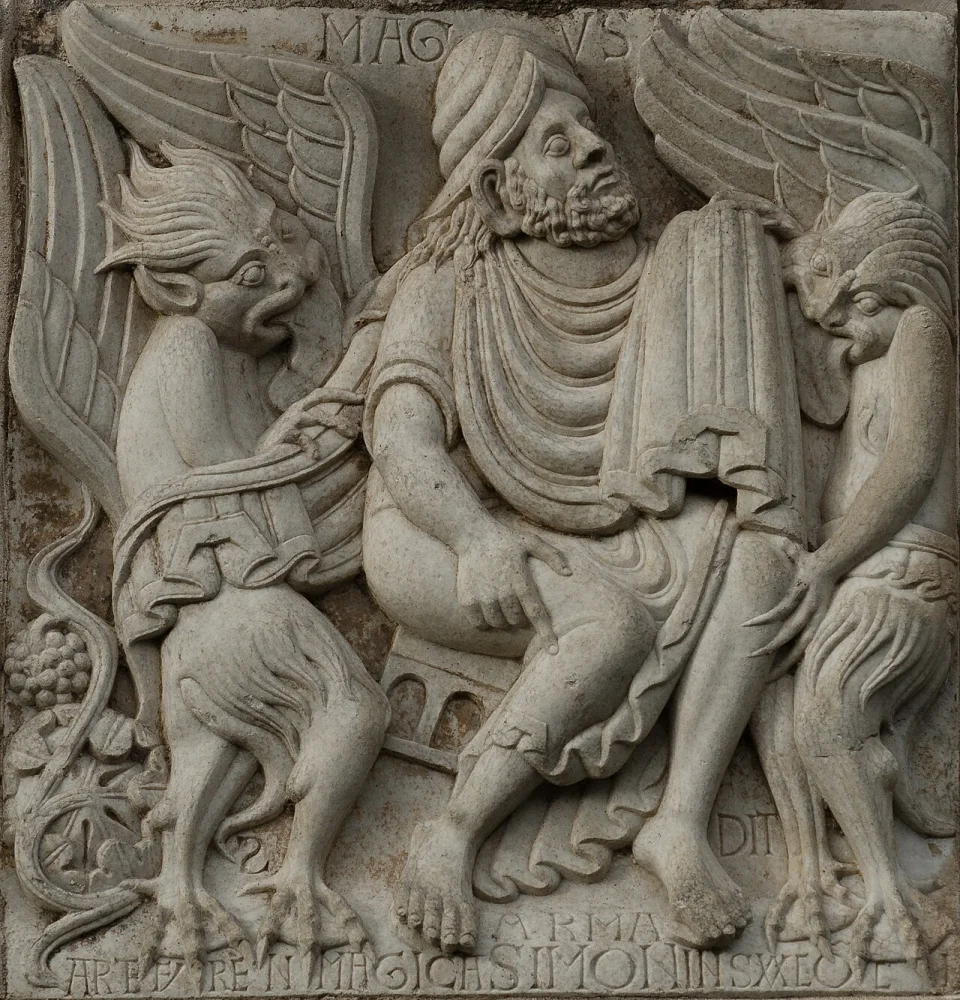
Simon Magus
- The encounter in Samaria
- The figure expands in later Christian writings
- Historical identity and legacy
Simon Magus is one of the earliest figures in Christian literature to be associated with magic, rivalry and religious authority. His story begins with only a few verses in the Acts of the Apostles: a Samaritan wonder-worker who is baptized after hearing Philip preach, then rebuked by Peter for trying to buy the power to bestow the Holy Spirit. Later Christian writers turned that brief encounter into a sprawling legend about a dangerous rival to the apostles and an ancestor of heresy.
The encounter in Samaria
The New Testament gives no birth date, family history or account of Simon’s later life. In Acts 8, he appears in Samaria, where the narrator says he had amazed people with magical acts and presented himself as an important figure. The people viewed him as possessing “the power of God that is called Great,” according to the passage.
When Philip preached about Jesus, Simon was among those who believed and were baptized. Later, Peter and John came to Samaria and prayed for the new believers to receive the Holy Spirit. Acts says Simon offered them money in exchange for the ability to confer that gift. Peter rejected the offer and warned him that spiritual authority could not be bought. Simon asked the apostles to pray for him, fearing the judgment Peter had pronounced.
This episode became the source of the term “simony,” meaning the buying or selling of spiritual offices or privileges. Acts itself does not say what happened to Simon afterward, or whether he remained within the Christian community.
The figure expands in later Christian writings
By the second century, Christian authors were describing Simon as the founder of a rival movement. Justin Martyr, who was himself from Samaria, identified Simon with a man from the Samaritan town of Gitta or Gitthon and said that followers honored him in Rome. The statue that Justin associated with Simon is now generally considered a likely misidentification of a monument to the Roman deity Semo Sancus.
Irenaeus of Lyon later portrayed Simon as the source of heresies and attributed to him an elaborate system of divine powers and emanations. In these accounts, a woman named Helen appears as his companion and as a figure of spiritual significance. The details come from opponents writing about movements they considered heretical; they do not provide a neutral record of what Simon himself taught.
Later apocryphal works, especially the Acts of Peter, developed Simon into Peter’s dramatic adversary in Rome. These stories describe a public contest of miracles and an attempted flight through the air that ends in Simon’s fall. They are religious literature, not independently verified accounts of historical events.
Historical identity and legacy
Modern scholars disagree about how much can be recovered about Simon as a historical individual. Some regard the figure in Acts as a literary construction; others think a real Samaritan teacher or wonder-worker may stand behind the tradition. The Simon of Acts, the founder described by second-century heresiologists and the magician in later stories may represent overlapping memories rather than a single consistent biography.
What is clear is that Christian writers used Simon as a way to debate who could claim spiritual power and how that power should be recognized. In Acts, the conflict centers on an attempt to purchase a gift of the Spirit. Later authors made him a symbol of false teaching, deceptive wonders and competition with apostolic authority. His influence on Christian history therefore comes less from a recoverable career than from the evolving story built around his name.
