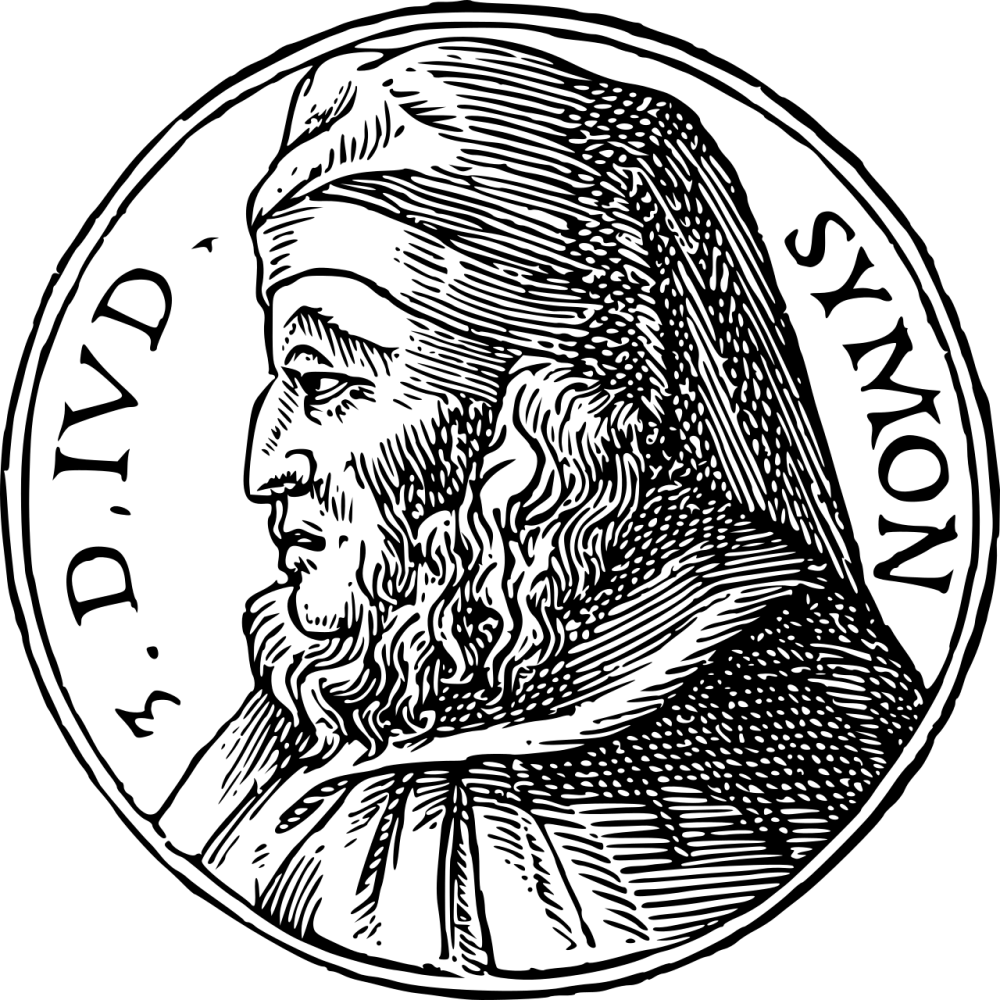
Simon Thassi
- A Family at the Center of Revolt
- High Priest and Ruler of Judea
- Expansion and the Seleucid Challenge
- Assassination and Succession
- Legacy and Significance
Simon Thassi helped turn the Maccabean revolt against Seleucid rule into a lasting political order in Judea. A brother of Judas Maccabeus and Jonathan, he became the movement’s leader after Jonathan was captured and killed. As high priest and ruler, Simon secured Jerusalem, strengthened the new government, and expanded its control to coastal towns. His career ended in a family betrayal that nearly destroyed the dynasty he had established.
A Family at the Center of Revolt
Simon was one of the sons of Mattathias, the Jewish priest whose family launched an uprising against the Seleucid king Antiochus IV in the 160s BCE. The revolt began in response to the king’s policies in Judea and the suppression of Jewish religious practices. Simon’s brothers Judas and Jonathan became prominent military leaders, while Simon contributed both military judgment and political authority.
After Judas died in battle in 160 BCE, Jonathan assumed leadership. He negotiated with rival claimants to the Seleucid throne, gaining recognition and eventually the high priesthood. But the shifting alliances of the Seleucid civil wars remained dangerous. In 143 BCE, the general Diodotus Tryphon seized Jonathan and later had him killed. Simon then emerged as the surviving leader of the Maccabean movement.
High Priest and Ruler of Judea
Simon’s rule began amid continuing threats from Seleucid forces and internal divisions. He fortified Jerusalem and secured key strongholds, including the citadel known as the Akra, which had housed a Seleucid garrison. He also took control of Joppa and Gezer, important sites connecting the interior to the coast. These moves strengthened Judea’s security and access to trade, though they provoked disputes with the Seleucid monarchy.
In 141 BCE, an assembly of priests, elders, and the people formally recognized Simon as high priest, military commander, and leader. The decree granted these offices to him and his descendants until a “faithful prophet” should arise, according to the account preserved in 1 Maccabees. That wording reflected both the practical need for stable leadership and a continuing expectation that the arrangement might not be permanent.
Under Simon, Judea gained substantial autonomy. Seleucid king Demetrius II confirmed exemptions from tribute, and documents began dating events by Simon’s rule. The agreement did not end all outside pressure, but it gave the state a measure of independence. Simon also cultivated diplomatic ties, including with Rome and Sparta, building recognition beyond Judea’s borders.
Expansion and the Seleucid Challenge
The next Seleucid ruler, Antiochus VII Sidetes, sought to restore royal control. He demanded that Simon return Joppa, Gezer, and Jerusalem’s citadel, or pay a large indemnity. Simon rejected the demand, arguing that these places had been acquired through defense and that Judea was not holding lands unjustly.
The resulting conflict showed the limits of the new independence. Antiochus besieged the coastal stronghold of Dor and sent forces against Judea. Simon maintained his position, but the contest continued into the reign of his successor. His achievements were therefore significant but precarious: Judea had strong institutions and control of strategic territory, yet its survival still depended on military strength and the unstable politics of the Seleucid kingdom.
Assassination and Succession
Simon’s final years were marked by a personal and political catastrophe. In 135 BCE, his son-in-law Ptolemy, governor of the Jericho district, invited Simon and his sons to a banquet at Dok. The gathering was a trap. Ptolemy had Simon and two of his sons killed, apparently in an attempt to seize power.
Simon’s son John Hyrcanus escaped the attack and succeeded him. He went on to rule Judea and extend Hasmonean power, carrying forward the political system his father had built. Simon was buried with his family at Modiin, where his sons erected a prominent monument visible from the surrounding area.
Legacy and Significance
Simon’s leadership marked the transition from rebellion to government. He consolidated the gains of the Maccabean uprising, secured a recognized high priesthood, and helped establish a hereditary ruling house. Later Hasmonean leaders would expand and reshape the kingdom, but Simon created the foundation on which their authority rested.
The principal narrative of his rule survives in 1 Maccabees, a work that celebrates his leadership and Judea’s liberation. Read as both a historical account and a partisan commemoration, it presents Simon as a stabilizing figure whose achievements were real but hard-won. His assassination underscores the vulnerability of the state he founded, even as his son’s succession ensured that the Hasmonean dynasty endured.