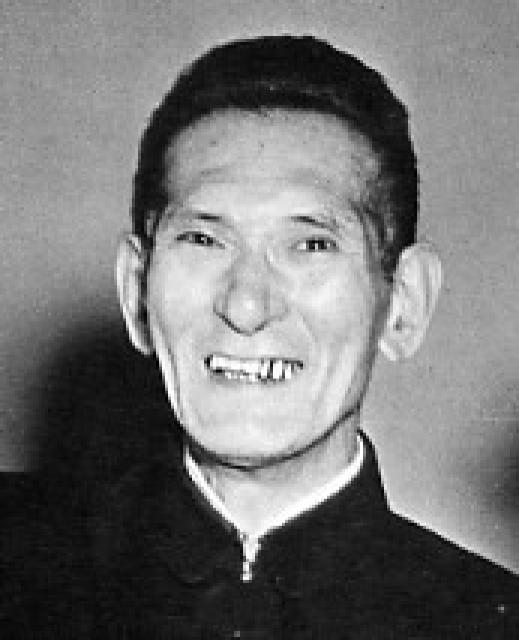
Siumey Okava
 Japan
Japan- Early Life and Education
- Nationalist Activities and Political Involvements
- Business Career and Railway Leadership
- Intellectual Pursuits and Political Activism
- Trial and Imprisonment
- World War II and Tokyo Trials
- Later Years and Legacy
- "Various Questions on the Revival of Asia" (1922)
- "A Textbook of Japanese History" (1931)
Early Life and Education
Shuumei Okawa, a prominent Japanese philosopher and political figure, was born in Sakata, Yamagata Prefecture, Japan. He graduated from the Department of Philosophy at the prestigious Tokyo Imperial University in 1911, specializing in classical Chinese and Indian philosophy and religion.
Nationalist Activities and Political Involvements
Throughout the 1910s, Okawa actively participated in various nationalist organizations. In 1918, he played a key role in the establishment of the Rosokai (Society of Old Comrades), which aimed to unite both right-wing and left-wing radicals with a strong nationalistic orientation. In 1920, the Yuzonsha (Society of Doubters)emerged from Rosokai, advocating for Japanese expansion into China.
Business Career and Railway Leadership
From 1918 onwards, Okawa held influential positions within the South Manchuria Railway Company. He served as a member of the board of directors in 1919, deputy director in 1923, and chairman of the board from 1923 to 1931. He also became the general manager of the East Asian Economic Research Institute in 1931.
Intellectual Pursuits and Political Activism
Okawa engaged in extensive journalistic and literary activities, traveling throughout Japan to deliver lectures. He was among the organizers of the unsuccessful March and October Incidents of 1931 and the mastermind behind the May 15, 1932 coup d'état that resulted in the assassination of Prime Minister Tsuyoshi Inukai.
Trial and Imprisonment
In 1934, Okawa faced trial for his involvement in the May 15 Incident, but he was only found guilty of inciting the rebels to commit crimes through his writings. He received a short prison sentence and was released in late 1935.
World War II and Tokyo Trials
During World War II, Okawa played a role in disseminating propaganda in Japan. In 1948, he was indicted as a Class A war criminal by the International Military Tribunal for the Far East (Tokyo Trials). However, he exhibited signs of mental illness during the trial and was declared unfit to stand trial.
Later Years and Legacy
Okawa's first Japanese translation of the Quran was published in 1950. He passed away in Tokyo in 1957. His selected works include:
"Various Questions on the Revival of Asia" (1922)
"A Study of the Japanese Soul" (1924)"A Study on the Establishment of Joint-Stock Colonization Companies" (1927)
"A Textbook of Japanese History" (1931)
"2600 Years of Japanese History" (1939)"A Chronicle of American and British Aggression in East Asia" (1941)
"Introduction to Islam" (1942)
"The Quran" (Japanese translation, 1950)