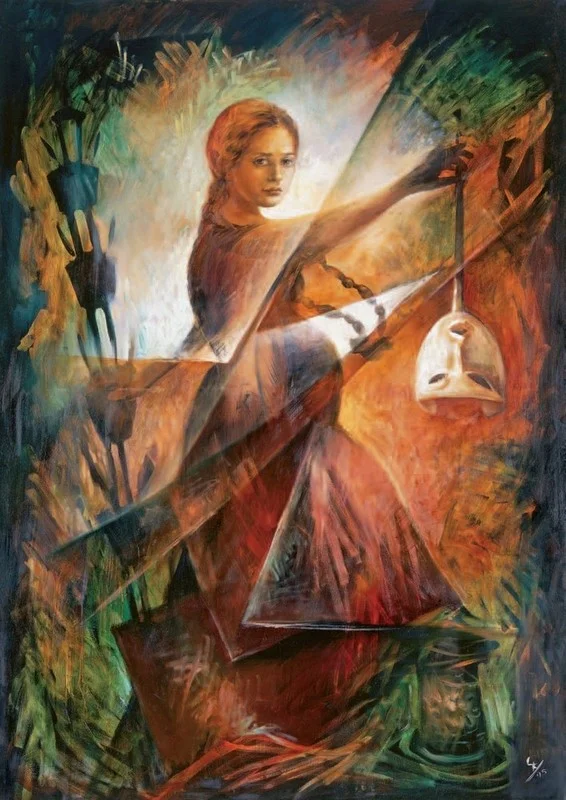
Tamar
- A Widow Waiting for Justice
- The Encounter on the Road
- Birth and Biblical Lineage
- Interpretation and Legacy
In one of the Hebrew Bible’s most arresting family stories, Tamar is denied the future promised to her and then takes a dangerous risk to secure it herself. Her story, told in Genesis 38, turns on widowhood, duty, deception and a public reversal: Judah, her father-in-law, first condemns her and then admits that she has been more in the right than he has. Later biblical genealogies give the episode a lasting place in the ancestry of King David and, in the Gospel of Matthew, Jesus.
A Widow Waiting for Justice
Genesis introduces Tamar as the wife of Er, Judah’s eldest son. Er dies, and Judah directs his second son, Onan, to fulfill the family obligation to provide an heir for his dead brother. Onan also dies. Judah then tells Tamar to return to her father’s household and wait until his youngest son, Shelah, is old enough to marry her.
The promise is never fulfilled. Tamar remains a widow while Shelah grows up, and Judah does not give him to her. The text explains that Judah feared Shelah would die as his brothers had. For Tamar, however, this leaves her suspended: the family duty that could secure her a child and a place in the household is withheld, while no alternative future is offered.
The Encounter on the Road
After Judah’s wife dies, he travels to Timnah for sheep shearing. Tamar learns of his journey, removes her widow’s clothing, covers herself with a veil and sits by the roadside. Judah mistakes her for a sex worker and negotiates an encounter, pledging his seal, cord and staff until he can send payment.
Tamar conceives. When Judah later sends a young goat to recover his pledged items, the woman cannot be found, and the objects remain with her. Some three months later, Judah hears that Tamar is pregnant and orders that she be brought out and burned. The severity of this judgment makes the next moment decisive: Tamar sends Judah the seal, cord and staff, saying that the owner of these objects is the father.
Judah recognizes them and acknowledges his responsibility. The biblical account gives his response as, “She is more in the right than I, since I did not give her to my son Shelah.” The admission shifts the moral focus of the story. Tamar has broken social expectations, but Judah’s failure to honor his promise and provide for her is exposed as the deeper wrong.
Birth and Biblical Lineage
Tamar gives birth to twin boys, Perez and Zerah. Their unusual birth scene echoes the biblical story of Jacob and Esau: a hand appears first, marked with a scarlet thread, but Perez ultimately emerges before his brother. Genesis identifies Perez as an ancestor of King David in the genealogy later presented in the Book of Ruth.
The Gospel of Matthew also names Tamar in its opening genealogy of Jesus, alongside several other women whose stories complicate and enrich the family line. This reference brought Tamar’s story into Christian interpretation as well as its central place in Jewish scripture and commentary.
Interpretation and Legacy
Genesis 38 interrupts the account of Joseph and his brothers, a placement that has long invited readers to consider how Tamar’s story connects with Judah’s transformation. The chapter shows Judah beginning as a man who abandons responsibility toward his daughter-in-law and ending as someone who publicly concedes that she was right. Tamar’s actions make that change possible, while the story keeps the unequal power between them in view.
Jewish interpretation has often emphasized her righteousness, modesty, or role in preserving the family line, though commentators have not understood every detail in the same way. Christian readings have likewise focused on her place in the ancestry of David and Jesus. Across these traditions, Tamar stands out as a woman whose brief appearance in the biblical narrative is defined less by passivity than by strategic action. Faced with a future others had promised and then denied her, she forces the family to confront its obligations and secures her place in its story.