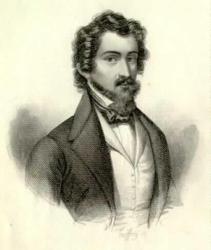
Taras Shevchenko
 Ukraine
Biography of Taras Shevchenko
Taras Hryhorovych Shevchenko, a great Ukrainian poet and writer, was born on March 9, 1814, in the village of Morintsy in the Cherkasy region. He became an orphan at an early age and received his education from a deacon. At the age of 14, he was taken as a "cossack" to the court of landlord P. Engelgardt, with whom he first moved to Vilnius and then to St. Petersburg.
In 1832, Shevchenko was apprenticed to the artist V. Shiryayev. In 1838, with the efforts of K. Bryullov, V. Zhukovsky, A. Venetsianov, N. Velgorskii, E. Grebinka, I. Soshenko, and others, Shevchenko was bought out of serfdom. In the same year, he was accepted into the Academy of Arts, which he graduated from in 1844. In 1843 and 1845, he visited Ukraine and worked as an artist in the Kiev Temporary Commission for the examination of old documents.
In February 1847, Shevchenko was appointed as a drawing teacher at the Kiev University. On March 24, 1847, he was arrested and sent as a soldier to the Orsk fortress of the Orenburg separate corps with a royal resolution banning him from writing and drawing. During his exile, Shevchenko, as an artist, was included in an expedition to study the Aral Sea. Thanks to the efforts of his friends, Shevchenko was released from exile in 1857. In 1858, he arrived in Moscow and then went to St. Petersburg. In 1859, he came to Ukraine, where he was under police surveillance. He was forbidden to permanently reside in Ukraine and was forced to move to the capital. Ten years of exile and illness led to Shevchenko's premature death on March 10, 1861. He was initially buried at the Smolensk Cemetery in St. Petersburg, but in May 1861, his remains were transferred to Chernetska (now Tarasova) Hill near Kaniv.
Works
Shevchenko began writing poetry in the second half of the 1830s. In 1840, his first collection of poems, "Kobzar," was published in St. Petersburg, followed by the heroic-romantic poem "Haidamaky" in 1845. From 1843 to 1844, he wrote a cycle of poems called "Three Summers" (with the main work being "The Dream"), the poem "Caucasus," the letter "To the Dead and the Living...," and poems such as "Chyhyryn, Chyhyryn," "The Great Pit," "In the Village of Subotove," and others, in which he sharply criticized the social and national oppression of the Ukrainian people. During his captivity, Shevchenko wrote poems, which he soon combined into a cycle called "In the Dungeon." From 1854 to 1858, he wrote short stories in Russian, including "The Musician," "The Artist," "The Unfortunate," "The Captain's Wife," and "The Twins." Shevchenko's last prose works are the novella "A Leisurely Stroll with Moral" and the diary entries in "Journal." In 1858, during his stay in Ukraine, Shevchenko wrote a series of high-quality intimate and landscape lyrics. Several works from this period were published in the journal "Osnova" and the almanac "Khata."
Art
Shevchenko is one of the most famous masters of Ukrainian painting. He worked in the fields of easel painting, graphics, monumental and decorative art, and sculpture. He excelled in the techniques of watercolor, oil, etching, pencil drawing, and pen. He is the author of over a thousand works of art (only about 160 have survived). In 1859-1860, he created etchings based on works by foreign and Russian artists, for which he received the title of Academician of Engraving.