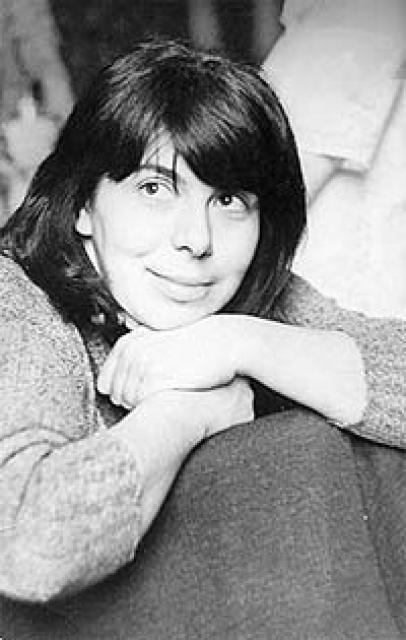
Tatiana Galushko
 Russia
Tatiana Galushko: A Biography
Tatiana Galushko was a poet, a scientific researcher at the A.S. Pushkin Apartment Museum on Moika Street, and a mother of three children. Her misfortunes began even before her birth. It has long been noticed that when conflicting words are forcibly combined in a message, the words themselves, contorting in convulsions, indicate that the whole message is a lie, or even slander. Here is an excerpt from an ordinary denunciation: "Tatiana Galushko has already read her mournful and spiteful poems 'about outcasts' from the stage of the House of Writers...". By declaring the poems both "mournful and spiteful," the authors reveal themselves completely. After all, the word "mourning" sounds so sublime that "spitefulness" next to it is impossible. The conclusion is obvious: Tatiana Galushko is simply being slandered. This is immediately confirmed by fabrications about the "Zionist orientation of her work." Osip Mandelstam also becomes a target. He, of course, is not particularly liked by the slanderers as a "Jew by origin," but in addition, it turns out that Tatiana Galushko admires him, so Mandelstam is also declared a "questionable poet." I came across this malicious document when reading Tatiana Galushko's book "Life. Poetry. Pushkin" (2003), compiled by Rona Zelenova and published by the journal "Zvezda" in St. Petersburg.
Early Life and Marriage
Tatiana Galushko was born into a difficult situation. In the early 1930s, as she approached her thirties, she lived alone in a five-meter room in an overcrowded apartment in St. Petersburg. She had no family or children, and at the toy factory where she worked, she had to attach heads, legs, and arms to pink celluloid dolls every day. When a new foreman named Kuzma Galushko appeared in the workshop and he and Tatiana fell in love, she saw the hope of marriage and having a child. According to Tatiana's relatives, maybe biased, Kuzma promised to marry her, hiding the fact that he already had a wife and son. In any case, Kuzma never denied his fatherhood, visited his daughter, and wanted to support her financially, but the offended mother refused.
Returning from the front as a major after several injuries, Kuzma finally managed to persuade Tatiana's mother to accept his help and allowed their daughter to take her father's surname, which she loved dearly. She even had a magical encounter: when she started working as a nurse in a hospital after school, she met a young doctor with the same last name, who turned out to be her older half-brother (from her father's side). Their father died shortly before this meeting.
A Life of Loss and Love
In the pedagogical institute, fate brought Tatiana together with the young poet Ryurik Shabalinsky. They got married and both attended the famous Leningrad Literary Association led by Gleb Semenov. There, they could hear emerging poets like the precise verse cutter Alexander Kushner, the posthumous Joseph Brodsky with his powerful, slightly disdainful howl, reminiscent of a deliberate contempt, and the thunderous Eugene Rein, who mesmerized with his boldness and analysis, as well as the bookish Jacob Gordin and the futurist-like Viktor Sosnor.
Tatiana's first poems were published by Sergei Dovlatov, who worked at the "Red Triangle" factory. There was, of course, no fee involved, but the publication itself was a source of happiness. However, Ryurik suddenly died of a heart rupture. Tatiana found herself in the same position as her mother, with her daughter in the same small room that hadn't increased in size over the years.
She lost friends, experienced deaths, departures, and betrayals. But she remained an idealistic, dark-eyed woman, with her eyes growing stronger and stronger with mourning.
But love came again, and Tatiana gave birth to two sons, becoming a mother of three children. She lived for them. Even the beloved snow, which she perceived as heavenly manna, could not distract her from her worries about the little ones: "Without haste, I will descend from the porch and stand under this heavenly manna, until the window shouts 'Mom!' - two frightened chicks."
She lost friends: there were deaths, departures, and betrayals. But she remained an idealistic black-eyed woman, with her eyes growing stronger and stronger with mourning.
Legacy and Reflections
Tatiana Galushko lived the life of a widow at the age of twenty-six, and it seemed like it would last forever: "I was a daughter. And a wife. / And became a mother. And a widow. / And stopped thinking that I should be happy." And her widowhood did not end with her alone: "Through the streets, oblivious to kinship, I walk as a widow of generations, to whom Moscow repented and then took back revelations."
But there was still love, and Tatiana gave birth to two boys, becoming a mother of three children. She now lived for them. Even the beloved snow, which she perceived as heavenly manna, could not distract her from her worries about her little ones: "Without haste, I will descend from the porch and stand under this heavenly manna, until the window shouts 'Mom!' - two frightened chicks."
She lost friends: there were deaths, departures, and betrayals. But she remained an idealistic, dark-eyed woman, with her eyes growing stronger and stronger with mourning.
Dr. Eduard Tropp, a doctor of physical and mathematical sciences, recalls: "This is not a fictional character, but reality. How many times, by chance or while performing some everyday task, the author met Tatiana Kuzminichna near the "Polytechnic" metro station or on Suvorov Square with that very wallet loaded with groceries and... manuscripts. Her listeners also didn't come to lectures in carriages and didn't hide their notes in fur muffs. Leningrad's researchers gathered from countless research institutes and "drawers" to immerse themselves in the "extraordinary romance" of the first third of the 19th century, to momentarily transform into the "ladies in morning dresses" from the "Verses about Women's Equality" and, following Tatiana Galushko, sigh: "We are far away. We can no longer return to the Sorot Grove. How sad..."
But let's turn to those who once slandered her in their denunciation. They are the head of the literary section of the Leningrad club "Russia" at the regional committee of the All-Union Leninist Young Communist League V.N. Shcherbakov and the members of the literary section V. Smirnov and N. Utekhin. I wonder how they are doing now, what they are up to? Perhaps they are still holding responsible positions or have become honored pensioners? I have no doubt that they were not harmed in any way. Our state is the most humane towards informants. And have they repented? Or do they still believe that they were right and hope that not everything is lost for them?


