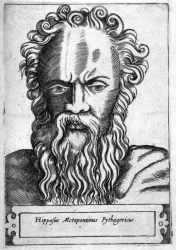
Theano
Theano is remembered as one of the most prominent women associated with the Pythagorean tradition of ancient Greece. She is usually placed in the sixth century BCE, although the surviving sources do not establish her dates or even the details of her family life with confidence. Her story is a reminder of both the intellectual roles women could occupy in ancient philosophical communities and the difficulty of recovering their lives from accounts written much later.
Life and the Pythagorean circle
Theano’s name appears in later accounts of the Pythagorean community, a movement linked to Pythagoras and active in southern Italy. Ancient writers variously described her as Pythagoras’ wife, daughter, or pupil; another strand associated her with the Pythagorean Brontinus. These conflicting family relationships cannot be reconciled with certainty. It is safest to say that tradition placed her among the women connected with the school, rather than to treat any one relationship as established fact.
The Pythagorean way of life joined philosophical inquiry to rules for conduct, communal discipline, and religious practice. Later sources present women as participants in this community and name Theano as its most famous female member. The accounts are valuable evidence for how the Pythagoreans and their successors imagined women’s place in philosophical life, though they do not amount to a contemporary biography.
Writings and ideas
Several works, sayings, and letters circulated under Theano’s name. A fragment associated with a treatise called On Piety survives in later testimony, and ancient lists attribute other writings to her. The surviving record does not provide a secure basis for identifying these texts as works she herself wrote. Pythagorean authorship was often assigned retrospectively, and writings under the names of early male and female followers were composed or adapted in later periods.
The texts attributed to Pythagorean women often address virtue, family life, and practical matters. They show how later readers used the authority of the Pythagorean tradition to discuss ethics and women’s roles. They may illuminate that reception more reliably than they reveal Theano’s own philosophy. Claims about her specific doctrines should therefore be treated cautiously.
Legacy
Theano’s place in the history of philosophy rests on a slender but persistent tradition. Her name endured as an example of a woman connected to one of antiquity’s best-known philosophical communities, even as her biography and literary legacy became layered with uncertainty. Modern accounts continue to discuss her both as a possible historical thinker and as a figure shaped by later Pythagorean memory.
That uncertainty does not make her unimportant. It highlights how little writing by ancient women survives under secure authorship, and how often later generations preserved women philosophers through stories and texts that are difficult to verify. Theano remains a focal point for questions about women’s participation in early Greek philosophy and about the evidence through which that participation is known.