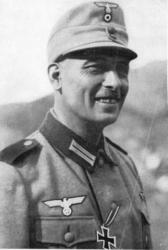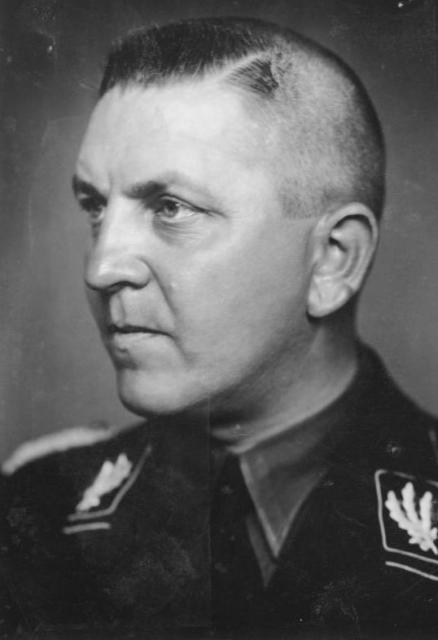
Theodor Eicke
 Germany
- Early Life and Military Career
- Rise in the SS
- Dachau and the SS "Death's Head" Division
- "Night of the Long Knives" and Inspector of Concentration Camps
- World War II and the 3rd SS Panzer Division "Totenkopf"
- Death and Legacy
Early Life and Military Career
Theodor Eicke was born on October 17, 1892, in Hudeingen, Alsace, to a railway station master. After being expelled from boarding school in 1909, he enlisted in the army. He fought in World War I, rising to the rank of sergeant on the Western Front.
Rise in the SS
In 1928, Eicke joined the Nazi Party (NSDAP) and its paramilitary wing, the SA. He quickly rose through the ranks of the Schutzstaffel (SS), a paramilitary organization led by Heinrich Himmler. His fanaticism for Nazi ideology earned him the position of commander of the Dachau concentration camp in 1933.
Dachau and the SS "Death's Head" Division
Under Eicke's command, Dachau became a model for other concentration camps, known for its brutal discipline and harsh treatment of prisoners. He established "Death's Head" units, SS units responsible for running the camps, which included notorious figures such as Adolf Eichmann and Rudolf Höss.
"Night of the Long Knives" and Inspector of Concentration Camps
Eicke was involved in the "Night of the Long Knives," a purge of Nazi rivals in 1934. He was promoted to SS-Gruppenführer and appointed Inspector of SS Concentration Camps, overseeing the expansion of the concentration camp system.
World War II and the 3rd SS Panzer Division "Totenkopf"
In 1939, Eicke formed the 3rd SS Panzer Division "Totenkopf." However, his fanaticism led to heavy losses, and he was criticized for his disregard for casualties. Despite this, he was awarded the Knight's Cross with Oak Leaves in 1942.
Death and Legacy
In February 1943, Eicke's division was sent to the Eastern Front, where he was killed in action on February 26, 1943. Eicke's legacy is one of brutality and fanaticism. He played a central role in the development of the Nazi concentration camp system and was responsible for the deaths of countless innocent people.