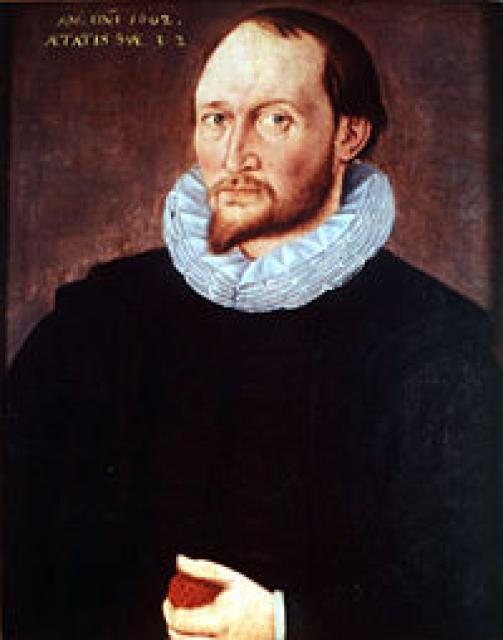
Thomas Harriot
 Great Britain
Biography of Thomas Harriot
Thomas Harriot was an English astronomer, mathematician, ethnographer, and translator. He made significant contributions to the field of mathematics by inventing the now universally recognized symbols for greater than (>) and less than (<). It is believed that he was the one who introduced potatoes to the British Isles. Harriot became the first person to map the Moon by observing it through a telescope on July 26, 1609, four months before Galileo.
After completing his studies at Oxford University, Harriot embarked on a journey to North and South America, accompanying the 1585 expedition to Roanoke Island. This trip was financed by Sir Walter Raleigh and led by Sir Ralph Lane. Harriot proved to be invaluable during the expedition and managed to grasp the basics of the Algonquian language, even developing good communication with two Native Americans. Upon his return to England, Harriot worked for the 9th Earl of Northumberland, who was a great patron of science. The generous Earl provided him with a laboratory, funds for research, and a house. With such support, Harriot became a prolific mathematician and astronomer, known for his theory of refracted waves.
Thomas Harriot was born around 1560 in Oxford. After completing university, he was hired by Sir Walter Raleigh as a mathematical tutor. Harriot also conducted navigation experiments, assisted with ship design for Raleigh, and worked as an accountant. Before his journey to America, he wrote a treatise on navigation. Later, Harriot developed a phonetic alphabet to decipher the Algonquian language.
Harriot participated only in the 1585-1586 expedition and spent a limited amount of time in the New World. However, it was enough for him to publish his account of the journey, "A Briefe and True Report of the New Found Land of Virginia," in 1588. His detailed report on how the indigenous population reacted to the expedition had a significant influence on subsequent colonists and explorers. When Sir Raleigh fell out of favor with the Queen, Henry Percy, the 9th Earl of Northumberland, became Harriot's new sponsor. However, Percy's indirect involvement in the Gunpowder Plot led to his imprisonment in 1605. Harriot was also interrogated and briefly imprisoned but was quickly released.
In 1607, Harriot became particularly interested in the Comet of Halley and decided to dedicate himself to astronomy. In early 1609, he acquired a "Dutch tube," a telescope invented the previous year, and used it for astronomical observations. Harriot is considered the first person to study an astronomical object using a telescope. On July 26, 1609, he created a map of the Moon and in December 1610, he observed and described sunspots. From 1615 to 1616, Harriot sent the results of his medical examination of his cancerous lip ulcer to one of his friends. He eventually succumbed to cancer.
In honor of Harriot, a genus of epiphytic cacti found in the tropical forests of Brazil was named after him. In 1970, an ancient large crater on the far side of the Moon was also named Harriot, as a tribute to the English astronomer. In some Russian sources, his name is occasionally spelled as Harriot or Harriot.


