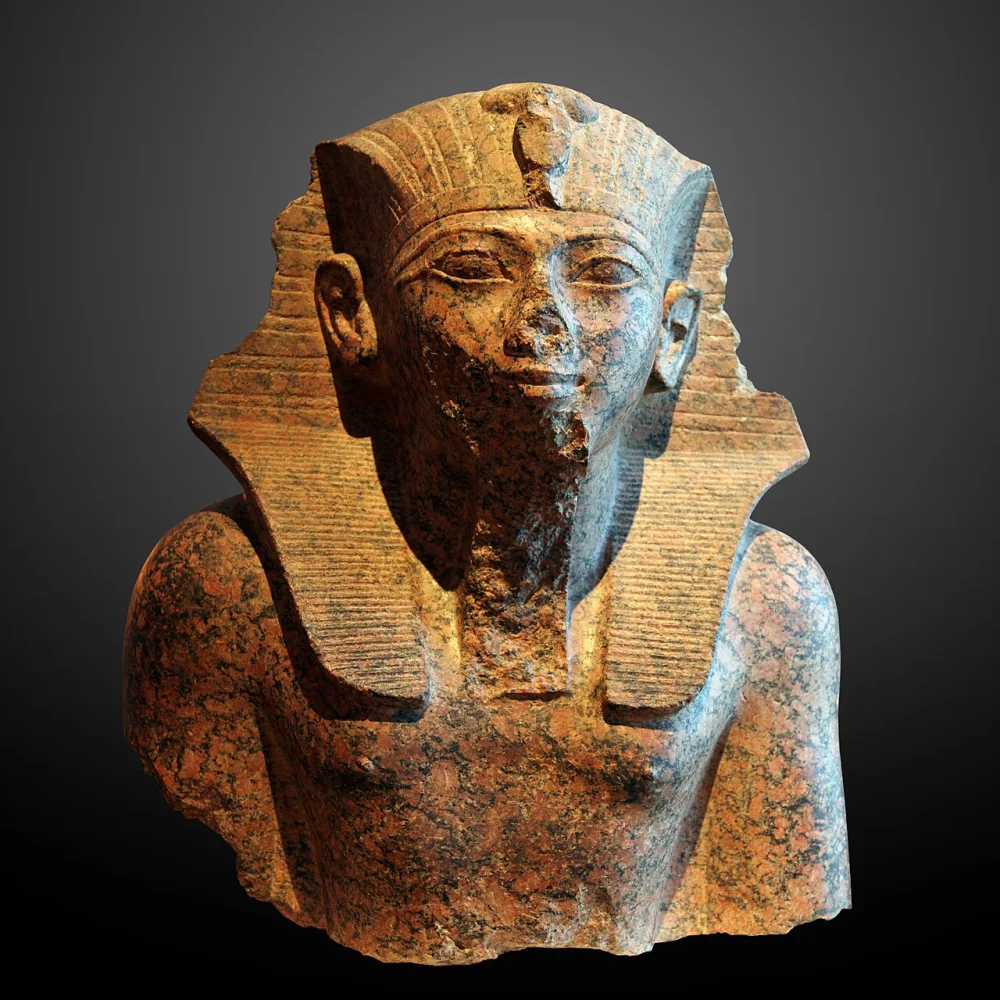
Thutmose IV
Thutmose IV was a pharaoh of Egypt’s Eighteenth Dynasty who ruled during the New Kingdom, around 1400 to 1390 BC. His reign is remembered for the Dream Stele he placed between the paws of the Great Sphinx at Giza and for a diplomatic opening toward Egypt’s rival kingdom of Mitanni. He was the son of Amenhotep II and the father of Amenhotep III, whose reign would mark a high point of Egyptian wealth and influence.
A Prince Becomes Pharaoh
Thutmose IV’s surviving monuments provide only a partial picture of his life and reign. He appears to have succeeded his father after the death of an older brother, though the precise circumstances of the succession remain uncertain. His choice to commemorate the Sphinx and its god in the first year of his reign has led some scholars to suggest that he needed to strengthen his claim, but the stele itself does not settle the question.
The inscription recounts a story from Thutmose’s youth. While resting in the shadow of the Sphinx during a hunting expedition, he dreamed that the divine being associated with the monument promised him kingship if he cleared away the sand covering its body. The prince later became king and restored the monument, setting up the stele to record the encounter. The dream is best understood as a royal account of divine favor: it linked the pharaoh’s rule to the Sphinx and its sacred power at Giza.
Diplomacy and the Egyptian Empire
Egypt remained a major power during Thutmose IV’s rule, but the balance of power in the Near East was changing. Rather than relying only on campaigns, he pursued closer relations with Mitanni, a powerful kingdom to the northeast. A diplomatic marriage alliance helped turn a long-standing rival into a partner and prepared the way for the more formal international ties that flourished under Amenhotep III.
This shift did not mean that Egypt abandoned military action. Inscriptions from the reign refer to campaigns and unrest in Nubia, south of Egypt, where the pharaoh sought to maintain Egyptian authority and access to valuable resources. Yet diplomacy became an increasingly important tool of foreign policy, distinguishing the period from the aggressive expansion of earlier Eighteenth-Dynasty rulers.
Thutmose also invested in royal monuments and temple construction. At Karnak, he completed and raised an obelisk originally commissioned by his grandfather Thutmose III. His projects and inscriptions presented him as a traditional warrior-king and a favored servant of the gods, even as his diplomacy brought new stability to relations with Mitanni.
Family and Legacy
Thutmose IV was succeeded by his son Amenhotep III. The evidence for the king’s private life is limited, and the identities and backgrounds of some royal women associated with the next generation remain debated. His relatively short reign is less richly documented than that of his son, but it helped shape the conditions in which Egypt’s later prosperity developed.
The Dream Stele remains the most vivid legacy of Thutmose IV. Its story blends religious devotion with political messaging, showing how a pharaoh could present his accession as part of a divine plan. Combined with his diplomatic engagement with Mitanni and his continued investment in royal monuments, the stele makes him a revealing figure in the transition from Egypt’s era of conquest toward a period of courtly wealth and international diplomacy.