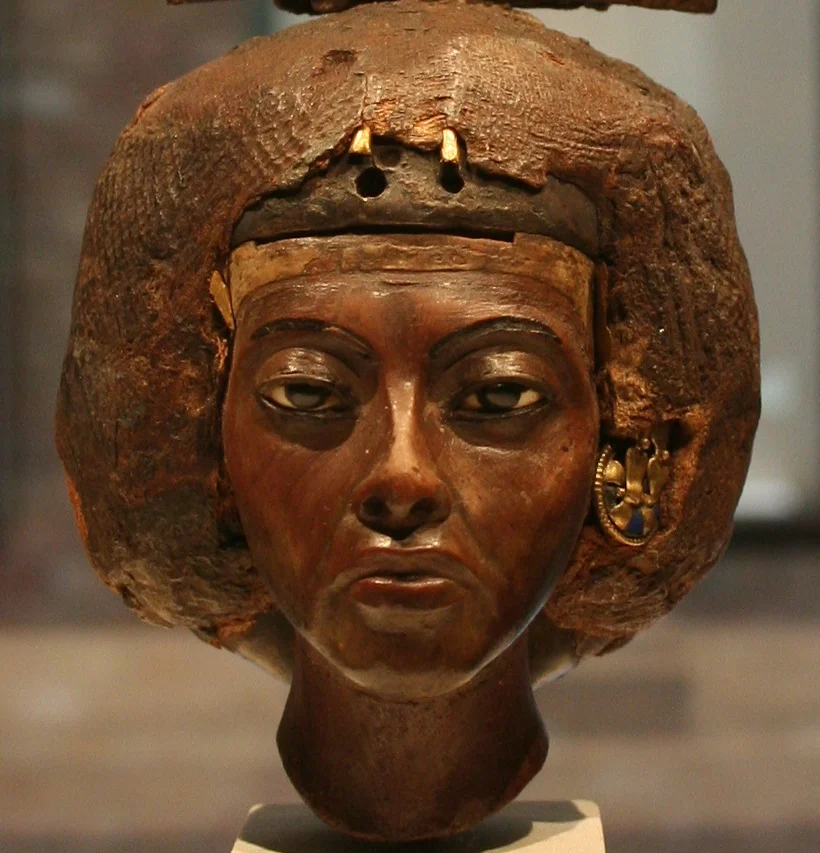
Tiye
Tiye was the Great Royal Wife of the Egyptian pharaoh Amenhotep III and one of the most prominent queens of the Eighteenth Dynasty. Born outside the royal family, she rose to a position of exceptional visibility at court. Monuments and diplomatic correspondence show that she remained an important figure during her husband’s reign and after her son Akhenaten came to power.
A queen from an elite family
Tiye was the daughter of Yuya and Thuya, a wealthy and influential couple from Akhmim in Middle Egypt. They were members of the elite but were not of royal descent. Amenhotep III married Tiye early in his reign, and the union was commemorated on royal scarabs, making her place in the dynasty unusually well documented.
The pharaoh’s Great Royal Wife held a central ceremonial role, and Tiye appears prominently in sculptures and temple art alongside her husband and their children. In some monuments her image is nearly as large as his, a striking visual statement of her importance. She was the mother of several royal children, including Amenhotep IV, who later took the name Akhenaten.
Influence at court and abroad
Tiye was more than a ceremonial consort. She is named in royal inscriptions and depicted across Egypt and Nubia, and foreign rulers knew her as a political figure. Letters from Tushratta, king of Mitanni, addressed to Tiye survive in the Amarna archive. Written after Amenhotep III’s death, they ask her to help preserve the diplomatic relationship Tushratta had enjoyed with her husband and appeal to her influence with Akhenaten.
The correspondence offers a rare view of a queen being addressed directly in international diplomacy. It suggests that Tiye retained standing after becoming queen mother, although the precise extent of her role in decision-making is difficult to determine from the surviving evidence.
Tiye lived through a period of dramatic religious change. Her son Akhenaten moved the royal court to Akhetaten, now known as Amarna, and promoted the worship of the Aten. Tiye’s name appears in material from this period, showing that she remained part of the royal family’s public life during the transition.
Legacy
The dates of Tiye’s birth and death are uncertain, but she likely lived into the early years of Akhenaten’s reign. Her parents’ richly furnished tomb in the Valley of the Kings, discovered largely intact in 1905, gave archaeologists an extraordinary glimpse into the wealth and status of the nonroyal family from which she came.
Tiye’s lasting significance lies in the rare visibility she achieved as queen and queen mother. Through her monuments and correspondence, she emerges not as a background royal figure but as a woman whose presence mattered at the Egyptian court and was recognized by rulers abroad.




