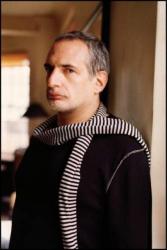
Trigon
 Moldova
Biography of Trigon
Trigon is a jazz trio that takes its name from a geometric figure based on three angles. It is also the name of a Moldovan group consisting of three musicians, each representing different musical worlds. Their music is a unique and diverse blend of Moldovan folklore, jazz, chamber instrumental music, rock, and funk. The musicians of Trigon are known for their experience, originality, and their commitment to improvisation and live performances.

The history of Trigon began in 1993 when the trio, consisting of Anatol Stepanță, Sergiu Testemițanu, and Oleg Baltagă, embarked on their first European tour after their debut concert in Chișinău. They performed at the 22nd Jazz Festival in Grenoble and since then, their presence and influence have steadily grown. Trigon has performed in various exotic locations, such as the ethnic music festival "Tabık" in Yakutia, and they have even traveled to New Zealand for the International Viola Congress.
In February of this year, Trigon held a series of presentation concerts in Moscow, with the most successful one taking place at the cultural center "Dom". This concert was in celebration of their latest album release, "The Voice of My Land". Trigon's leader, Anatol Stepanță, sat down for an interview with Vasily Kostyrko from "Alfavit" magazine.
Anatol Stepanță shared that his connection to folk music began at a young age when he first heard folk melodies from his grandfather, who played the violin and became his first teacher. He revealed that he comes from a family of musicians, with his grandfather being a celebrated musician and his father and uncles also following in his footsteps. This musical dynasty has continued through the generations, and Anatol feels fortunate to be a part of it.
The conversation delved into the perception that incorporating folklore into modern art could be seen as a rejection of conscious creative decisions. Anatol disagreed, stating that Trigon sees folklore as an integral part of their music and they aim to combine it with elements of improvisation. He credited his meeting with Misha Alperin as a turning point, where he was introduced to Oleg Baltagă and Sergiu Testemițanu. They began improvising on folk themes during their first rehearsal and discovered that they couldn't abandon the stage rules even if they wanted to because every stage has its own standards.
Anatol Stepanță recalled his childhood memories associated with folk music, growing up in a village near Bălți, Moldova's second-largest city. He reminisced about seeing his grandfather playing the violin while his grandmother danced. His grandfather was a true "lăutar" and would always grab his violin whenever he had a little drink. Anatol's connection to folk music was further solidified by his experiences playing at weddings from a young age. Moldovan weddings are known to be special events, with the entire village gathering, ranging from 500 to 1000 people.
Playing at weddings became a way for Anatol and his bandmates to gather experiences, which they later incorporated into their first album titled "Jazz Wedding in Moldova". The album featured various folk-inspired pieces, including a dance by a drunk policeman, a melancholic song by the bride's father, and a waltz for the elderly. Anatol explained that musicians are typically invited to play from 3 pm until 7 am, and they are expected to continue playing until the end, even if the most enthusiastic guests have fallen asleep face-first in their plates of "holodets" (meat jelly).
Anatol also shared a memorable story from a wedding where the band was not paid after their performance. In response, they kidnapped the groom and held him in a cellar until the father of the groom brought the money. Anatol emphasized that for many musicians, weddings are still a means of survival.
The interview then touched upon Anatol's unique role as an alto violinist in Trigon. He explained that in the Balkan region, the alto violin has never been a solo instrument but rather played a supporting role. However, he found inspiration in Romanian folklore, where he discovered three pieces where Efta Botoca, a Romanian violinist, soloed on the alto. After filling in for an absent altoist during a concert, Anatol ended up staying in the folk orchestra for five years. During this time, he started composing melodies for the alto. In fact, he proudly mentioned that he was the first to record and release a compact disc of folk music on the alto violin in the Balkan region.
The conversation then turned to Trigon's extensive touring in Europe. Anatol shared that their first tour was a significant milestone, where they composed seven new pieces within six months and performed them in France. Their second concert was at the renowned 22nd Jazz Festival in Grenoble, where they felt the additional pressure of sharing the stage with the famous Michel Petrucciani and his string quartet. Despite the nerves, the concert was a success, and they were asked to perform several encores, even though they had no other pieces prepared, so they ended up playing four of their previously performed pieces again.
Anatol fondly recalled a tour in the Netherlands, where the organizers arranged for Trigon to perform in two Catholic churches. The idea of performing their lyrical and, in Anatol's words, "banal" pieces in a church made them nervous, but they managed to adjust their sound and play without amplification, creating a unique atmosphere. He regretted not having a video recording of that performance.
Throughout the interview, Anatol emphasized that the more nervous they feel before a concert, the better the performance turns out to be. Trigon continues to captivate audiences with their fusion of Moldovan folklore and jazz, bringing their unique sound to audiences around the world.