
Tsiprian Norwid
 Poland
Early Life and Education
Cyprian Norwid was born in Poland and became an orphan at a young age. He was raised by his grandmother and attended a gymnasium in Warsaw with his older brother Ludwik. Although he did not complete the fifth grade, he enrolled in a private art school to pursue his passion for the arts.
Literary and Artistic Career
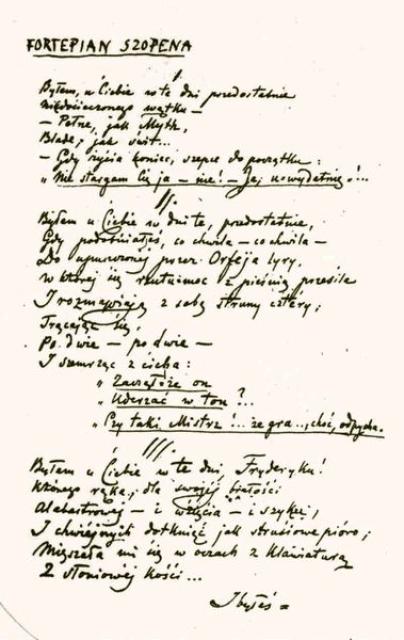
Norwid made his debut in the literary world in 1840 with the publication of his poem "My Last Sonnet" ("Mój ostatni sonet"). In 1842, he legally traveled to Dresden to improve his skills in sculpture but decided to stay abroad. He lived in Venice and Florence before settling in Rome in 1844. While in Berlin, he attended lectures at the university and engaged with Polish emigrant communities. However, in 1846, he was arrested and expelled from Prussia. He then lived in Brussels and later returned to Rome, where he met Adam Mickiewicz and Zygmunt Krasiński. From 1849 to 1852, he resided in Paris and formed connections with Juliusz Słowacki, Frédéric Chopin, Ivan Turgenev, and Aleksandr Herzen.

Struggles and Experiences
Norwid faced financial difficulties, criticism from the literary community, and misunderstandings in his relationships with others. His health also declined over time, resulting in loss of vision and hearing. In November 1852, with the assistance of Władysław Zamoyski, he emigrated to the United States. He worked in a graphic design workshop in New York City in 1853. Upon learning about the start of the Crimean War, he made efforts to return to Europe. He returned to London in the summer of 1854 but struggled to make a living through odd jobs. After returning to Paris, he managed to publish several works.
Later Life and Legacy
From February 1877, Norwid lived in a Polish charitable shelter on the outskirts of Paris in Ivry, where he passed away. His remains were interred in a common grave for unknown Polish vagrants at the Montmartre Cemetery. Norwid's works include novellas ("Ad leones!", 1883, among others), poems, and dramas. Some of his notable works include the poetic cycle "Vade mecum" (1865-1866), the philosophical poem "A Dorio ad Phrygium" (1871), and the tragedies "Behind the Scenes" (1865-1866), "Cleopatra" (Kleopatra i Cezar, 1870-1872), and "The Great Lady's Ring" (Pierścień Wielkiej Damy, czyli Ex-machina Durejko, 1872). Only a small portion of his poetry and prose was published during his lifetime, with much of his legacy lost. However, Norwid gained posthumous recognition, particularly after Polish critic Zenon Przesmycki "discovered" him in 1904 and began publishing his works and writing about his artistry. Norwid is now considered one of the most prominent Polish poets, alongside Mickiewicz and Słowacki, overshadowing Krasiński. A complete collection of his works was published in eleven volumes in Warsaw between 1971 and 1976.




