Tulsidas
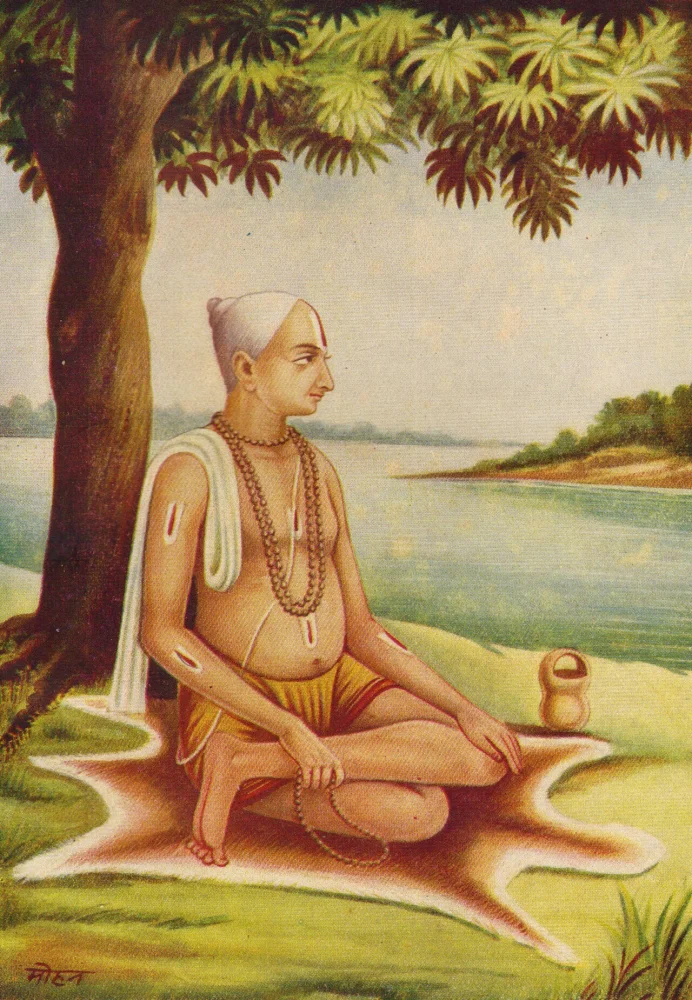
Tulsidas was a Hindu poet and devotional teacher, traditionally dated to 1532–1623, whose works shaped the worship of Rama across northern India. He is best known for the *Ramcharitmanas*, an influential retelling of the *Ramayana* in Awadhi, and is traditionally credited with the popular hymn *Hanuman Chalisa*. His poetry brought complex sacred narratives into the language of everyday devotion and remains central to religious life and performance.
A life known through tradition
Tulsidas is usually associated with Rajapur in present-day Uttar Pradesh and with Varanasi, where he spent much of his life. The dates and details of his biography are uncertain. Modern accounts draw on a small amount of evidence in his own writings, later biographies and devotional traditions, which do not always agree.
A popular story says that Tulsidas was married to Ratnavali and that her rebuke of his attachment to her inspired him to renounce household life and devote himself to Rama. This account became a memorable part of his saintly biography, but it appears in sources written long after his lifetime and cannot be treated as firmly established fact.
The *Ramcharitmanas*
Tulsidas composed the *Ramcharitmanas* in Awadhi, a language widely spoken in northern India. The work retells the life of Rama, drawing on the Sanskrit *Ramayana* and other religious traditions while giving the story its own theological and poetic shape. Devotees regard Rama not only as an ideal king and hero but as the supreme divine presence.
The poem is organized into seven books and became a foundational text for Rama devotion. Its accessible language helped make the narrative available to audiences beyond those trained in Sanskrit. It is recited in homes and temples, sung in public gatherings and performed in the dramatic tradition of *Ramlila*.
Other works and devotion
Tulsidas is also traditionally credited with the *Hanuman Chalisa*, a forty-verse hymn praising Hanuman that is among the best-known devotional compositions in Hindi-speaking communities. Other works associated with him include *Vinaya Patrika*, *Kavitavali* and *Dohavali*, which express devotion to Rama through prayer, narrative and moral reflection.
His writing reflects the broader bhakti movement, which emphasized a personal relationship with the divine through love, remembrance and praise. Tulsidas’s poetic voice joined reverence for scripture and Sanskrit learning with literary forms that could be shared by a much wider public.
Legacy
Tulsidas became one of the most influential poets in the development of Hindi literature and north Indian religious culture. The *Ramcharitmanas* continues to guide worship and shape ideas of duty, compassion and kingship, while the *Hanuman Chalisa* is recited by millions. His historical life remains partly obscured by legend, but the reach of his work is unmistakable: he made Rama’s story a living part of everyday language and devotion.