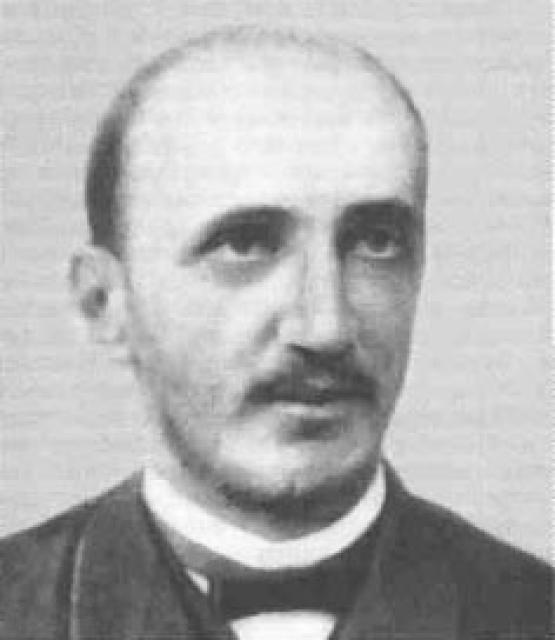
Ulian Kulakovskiy
 Russia
- Julian Kulakovsky: An Eminent Scholar and Historian
- Academic Career
- Scholarly Contributions
- Institutional Participation
- Political Involvement
- Personal Life and Later Years
Julian Kulakovsky: An Eminent Scholar and Historian
Early Life and EducationJulian Andreevich Kulakovsky was born into a family of priests in the Lithuanian diocese. He was the younger brother of the prominent scientist and activist P. A. Kulakovsky. Following his graduation from the Lyceum of Tsarevich Nicholas with distinction, Kulakovsky became a student at the University Department of the Lyceum in Moscow. In 1876, he earned a candidate's degree in classical philology from the Moscow University Council.
Academic Career
From 1876 to 1877, Kulakovsky served as a senior tutor's assistant, teaching Latin at the Lyceum. In 1877, he was granted a two-year scholarship for scholarly research abroad. Upon his return, he was appointed as a private docent at the Kiev University of St. Vladimir in Roman literature in 1881. In 1883, he defended his dissertation on "Collegia in Ancient Rome," earning a master's degree in Roman literature. He became an associate professor in 1884.
Scholarly Contributions
Kulakovsky's most renowned work was his three-volume "History of Byzantium." He also made significant contributions to the study of Greek and Roman literature, and was awarded the Makariev Gold Medal by the Academy of Sciences in 1903 for his review of V. I. Modestov's "Introduction to Roman History."
Institutional Participation
Kulakovsky was a member of the Council of the Kiev University, the professorial disciplinary court, and various other scientific societies. He also served as the secretary of the Historical and Philological Faculty at the university.
Political Involvement
Kulakovsky actively participated in the monarchist movement, joining the Russian Assembly in 1906 and the Council of the Kiev Club of Russian Nationalists in 1909. He was a vocal supporter of Tsar Nicholas II and took part in anti-liberal rallies.
Personal Life and Later Years
Kulakovsky's wife, Lyubov Nikolaevna, passed away in 1914. After the revolution, Kulakovsky's life became increasingly difficult, both physically and emotionally. He died in his cold Kiev apartment shortly after the city was captured by Bolsheviks in 1919. The exact location of his burial remains unknown.



