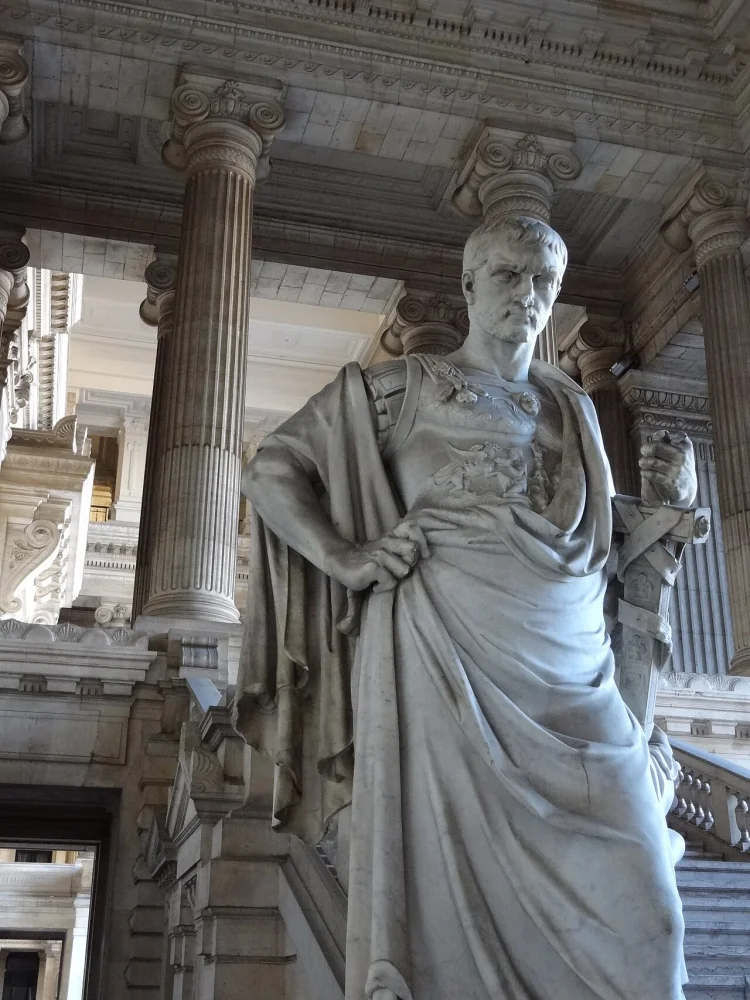
Ulpian
Ulpian was one of the most influential legal writers of the Roman Empire. Born in Tyre, he rose through imperial service to become a senior adviser and praetorian prefect under Emperor Severus Alexander. His career ended violently when he was killed by soldiers in the mid-220s. Centuries later, Justinian’s legal scholars preserved so much of Ulpian’s work that his voice became central to the study of Roman law.
From Tyre to imperial service
Known in Latin as Domitius Ulpianus, he came from Tyre, a prosperous city in the Roman province of Phoenicia. The exact date of his birth is unknown, and surviving sources say little about his family or private life. His education and legal ability brought him into imperial administration during the Severan dynasty, when emperors relied on trained jurists to draft rulings and handle petitions.
Ulpian served in several legal offices and worked alongside the jurist Papinian. He wrote extensively on civil law, the praetorian edict, criminal procedure, and the responsibilities of provincial governors. His practical experience at court gave his writing a close connection to the daily work of government: how magistrates should exercise authority, how legal rules applied to disputes, and how imperial decisions could shape the law.
A jurist with power
Under Emperor Severus Alexander, Ulpian rose to the rank of praetorian prefect, one of the highest offices in Rome. The prefect was both a senior administrator and a commander of the Praetorian Guard. Ulpian’s legal learning and influence at court placed him in a position of exceptional power, but his authority also created enemies among the soldiers.
Ancient accounts connect his death to conflict with the guard. After an earlier confrontation under Emperor Elagabalus, he returned to high office under Alexander. At some point in the mid-220s, praetorian soldiers killed him during unrest at the imperial court. The details are uncertain, but his murder reveals how precarious life could be even for a powerful official when military factions turned against him.
Writings that survived
Ulpian produced a vast body of legal commentary, including an eighty-three-book analysis of the praetorian edict and a fifty-one-book commentary on civil law. Most of his original works have not survived intact. Their influence comes through excerpts selected in the Digest of Justinian, compiled in the sixth century. Roughly a third of that collection is attributed to his writings, making him the most heavily represented jurist in the work.
The Digest preserved his analyses on subjects ranging from property and contracts to public administration and family law. One of his widely quoted formulations distinguishes public law, which concerns the Roman state, from private law, which concerns individual interests. His texts became a key bridge between classical Roman legal practice and the later civil-law traditions of Europe.
Legacy
Ulpian’s personal history remains fragmentary, but his legal thought endured because later compilers treated his writings as authoritative. Medieval and modern lawyers encountered Roman law largely through the Digest, where Ulpian’s reasoning appears on page after page. His career captures a distinctive Roman reality: legal expertise could place a scholar close to imperial power, while the same court politics could make that position dangerous.