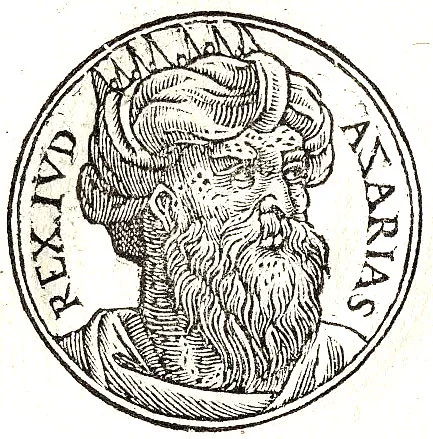
Uzziah
A long reign in Judah
Uzziah, also called Azariah, was a king of Judah in the eighth century BCE. He was the son of Amaziah and Jecoliah of Jerusalem. The biblical books of Kings and Chronicles both describe his long rule, though they use different names for him and give different amounts of detail. Modern chronologies commonly place his reign around 792/791 to 740/739 BCE, while the biblical account gives it as fifty-two years.
The sources say Uzziah became king at sixteen. His reign coincided with a period when both Judah and the northern kingdom of Israel grew in strength. The account in 2 Kings is brief, noting that he did what was right in the sight of God, that he regained Elath for Judah, and that he suffered from a skin disease in later life. The much fuller account in 2 Chronicles presents him as a capable ruler whose success brought both prosperity and, ultimately, religious conflict.
Building power and prosperity
According to Chronicles, Uzziah strengthened Judah’s defenses, built towers in Jerusalem and the countryside, and developed the army’s equipment. The text also connects his rule with farming and with influence over neighboring peoples. These reports portray a kingdom with growing military and economic capacity, although historians treat some of the territorial claims cautiously because they are not independently confirmed in detail.
The biblical account describes Uzziah as a builder and organizer as well as a military leader. His reign is associated with a broader flourishing in Judah during the eighth century BCE, a period reflected in the prophetic books of Amos and Isaiah. Isaiah’s account opens with a vision “in the year that King Uzziah died,” making the king’s death a marker for a moment of political and religious transition.
The temple episode
The story of Uzziah’s final years is told most fully in Chronicles. As he grew powerful, the text says, he became proud and entered the Jerusalem Temple to burn incense, a duty reserved for priests. Azariah the priest and eighty other priests confronted him. Uzziah became angry, and the narrative says a skin disease appeared on his forehead. He lived apart from the royal household afterward, while his son Jotham administered the kingdom.
This episode is presented in Chronicles as a warning against a king crossing the boundaries of his authority. Kings also reports Uzziah’s skin disease and says Jotham governed during his father’s illness, but it does not recount the temple confrontation. The accounts agree on the illness and transfer of day-to-day rule, while the Chronicler gives those events a strong religious interpretation. The ancient term traditionally translated as “leprosy” can refer more broadly to a skin condition and should not automatically be equated with modern leprosy.
Death and memory
Uzziah died and was buried with the kings of Judah, though Kings specifies that his burial was in the royal burial ground. A later Aramaic stone plaque, generally dated to the Second Temple period, records that the bones of “Uzziah, king of Judah” had been brought to a new place and warns against opening it. The inscription reflects a later memory of the king and a reburial tradition; it is not a contemporary record from his reign.
Uzziah’s historical profile is therefore shaped chiefly by biblical narratives, with archaeology offering only limited support for the details of his rule. He remains a prominent figure in the history of Judah: a long-reigning monarch remembered for the kingdom’s strength, for the limits placed on royal authority, and for the transition to his son Jotham.


