Valter Zeydlits-Kurtsbah
 Germany
Biography of Walter Zeidler-Kurtzbach
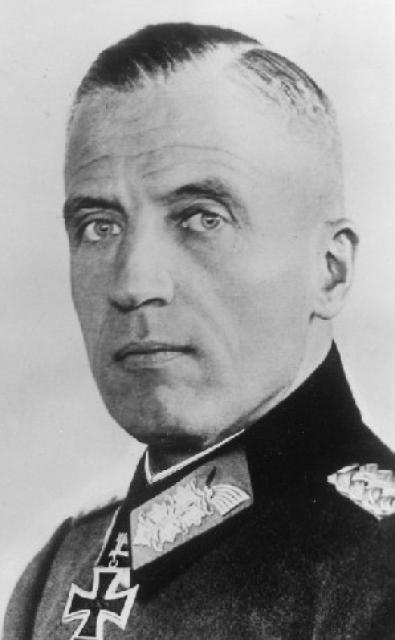
Walter Zeidler-Kurtzbach was a German military figure and artillery general. He was born into a family of military background to his father Alexander von Zeidler-Kurtzbach, who later became a lieutenant general. Walter was the third of ten children. His two older brothers, Heinrich and Wolfgang, lost their lives on the fronts of World War I. Walter also participated in the Battle of the Somme in 1916.
He joined the army on September 18, 1908, and received military training in Danzig and at the military academy in Hanover. During the First World War, Zeidler-Kurtzbach fought on the Eastern Front and was wounded multiple times. He received the Iron Cross 1st and 2nd class, the Order of the House of Hohenzollern, the Hanseatic Cross, and the Silver Wound Badge for his bravery.
Zeidler-Kurtzbach was known for his passion for horse riding and participated in horse races. After the war, he became the commander of a battery and later served as a captain in the 2nd artillery regiment in Schwerin.
With the outbreak of World War II, Zeidler-Kurtzbach commanded an artillery unit on the German-Dutch border. He was promoted to major general and later became the commander of the 12th Mecklenburg Infantry Division. He played a significant role in the breakthrough of the Maginot Line and the crossing of the River Somme during the French campaign in 1940.
In 1941, Zeidler-Kurtzbach participated in the battles on the Eastern Front and distinguished himself in the defense of Nevel and the prevention of Soviet breakthroughs. He was promoted to lieutenant general and reassigned to the reserve by Adolf Hitler in 1942.
Zeidler-Kurtzbach returned to the Eastern Front in March 1942 and formed a combat group consisting of three divisions. Their mission was to relieve the encircled 2nd Corps near Demyansk. Despite the successful operation, Hitler refused to withdraw the trapped troops. Zeidler-Kurtzbach was then appointed commander of the 51st Corps, which played a vital role in the second battle of Kharkov and the Stalingrad campaign.
During the Battle of Stalingrad, Zeidler-Kurtzbach's corps managed to capture Mamayev Kurgan and reach the Volga River. However, the German forces were ultimately defeated. Zeidler-Kurtzbach repeatedly urged his superiors to allow a breakout from the encirclement, but his requests were denied.
After the surrender of the 6th Army in Stalingrad, Zeidler-Kurtzbach was imprisoned by the Soviets. In captivity, he decided to collaborate with the Soviet authorities in an effort to overthrow Hitler, whom he blamed for the demise of the 6th Army. He was elected chairman of the Union of German Officers, a group operating under Soviet control.
Despite his efforts, Zeidler-Kurtzbach's collaboration did not yield significant results. After the war, he was sentenced to 25 years in prison for war crimes by a Soviet military court. He was held in solitary confinement and subjected to psychological torture for several years. In 1955, he was released and allowed to return to Germany after the intervention of West German Chancellor Konrad Adenauer.
Zeidler-Kurtzbach lived the rest of his life in seclusion. He was officially rehabilitated by the General Prosecutor's Office of the Russian Federation in 1996, two decades after his death.