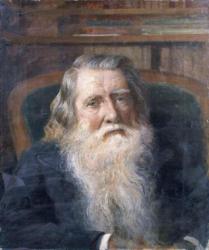
Vladimir Gringmut
 Russia
- Early Life and Education
- Education
- Career
- Publicism and Editorship
- Political and Social Activity
- Education and Religious Reforms
- Death and Legacy
- Memorialization
- Impact
- Family
Early Life and Education
Birth and AncestryVasily Apollonovich Griengmut was born in Moscow on an unspecified date. His paternal ancestors were a noble Slavic family from Prussian Silesia. His grandfather served as the mayor of Liegnitz.
Education
Despite lacking a formal gymnasium education, Griengmut enrolled as a volunteer auditor at Moscow University in 1866. He studied classical languages and was influenced by Professor P. M. Leontiev.
Career
Teaching and AdministrationAfter his father's death in 1870, Griengmut was appointed a junior tutor at the Lyceum of Cesarevich Nicholas. He later obtained a diploma as a teacher of classical languages in 1874. On January 1, 1894, he became the director of the Lyceum.
Publicism and Editorship
Griengmut began his journalistic career in 1871, contributing to M. N. Katkov's publications, "Moskovskie Vedomosti" and "Russkiy Vestnik." He later became a member of the editorial board of "Moskovskie Vedomosti" and the chief editor in 1896.
Political and Social Activity
Griengmut was an active member of the right-wing monarchist movement. He was involved in the establishment of the Russian Assembly and played a leading role in the foundation of the Russian Monarchist Party (RMP) in 1905. He also created the All-National Russian Union in November of that year.
Education and Religious Reforms
Concerned about the influence of liberal ideas in education, Griengmut advocated for the creation of a Russian national school system based on religious and moral values. He established "Kirill-Mefodiyev" schools and lobbied for temperance initiatives.
Death and Legacy
Passing and BurialGriengmut passed away on September 28, 1907, from pneumonia. He was buried at the Skorbyshchensky Monastery cemetery in Moscow.
Memorialization
In 1909, a settlement in the Far East was named Griengmutovka (currently known as Terney) in his honor. A church dedicated to his patron saint was also built there.
Impact
Griengmut's influence on the right-wing monarchist movement was significant. He played a key role in organizing and unifying monarchist organizations. He is remembered for his political and social ideas, and particularly for his advocacy for a strong, autocratic Russian state based on traditional values.
Family
Little is known about Griengmut's family. He had four daughters. His nephew, Evgeny D. Grienev-Griengmut, was executed in 1937.