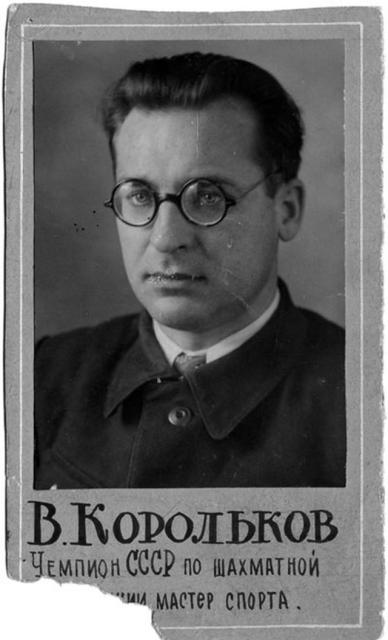
Vladimir Korolkov
- Vasily Korolkov: Soviet Chess Composer Par Excellence
- Transition and Refinement
- Accolades and Recognition
- Publications and Collaborations
- Personal Life and Legacy
Vasily Korolkov: Soviet Chess Composer Par Excellence
Early Life and InfluencesVasily Korolkov, born to a railway worker in the Soviet Union, embarked on his chess composing journey in 1926. His initial style leaned towards the "romantic," where he reveled in eccentric and paradoxical themes. However, this approach drew criticism for its artificiality and lack of practical relevance.
Transition and Refinement
Undeterred by critique, Korolkov gradually incorporated feedback into his compositions. His ideas remained vibrant and innovative, but he refined their execution, imbuing them with a greater sense of elegance.
Accolades and Recognition
Korolkov's ingenuity garnered accolades. He authored over 300 etudes and 230 chess problems, primarily in non-classical genres like cooperative and reverse checks. His works earned him over 350 distinctions, including approximately 70 first-place prizes. As a testament to his brilliance, he triumphed in three USSR etude championships: 1929, 1948 (shared with Mikhail Liuburkin), and 1965. Moreover, he collaborated with Lev Mitrofanov to claim three gold medals in the FIDE etude competitions from 1958 to 1962.
Publications and Collaborations
Beyond his own compositions, Korolkov contributed extensively to chess literature, publishing over 100 articles, editing anthologies, and authoring a personal collection of etudes. His expertise extended to editorial roles in chess publications and newspaper sections.
Personal Life and Legacy
Korolkov's wife, Olga Semyonova-Tyan-Shanskaya, was a two-time USSR chess champion and granddaughter of renowned geographer Pyotr Semyonov-Tyan-Shansky. They had two children, Nadezhda and Alexander. In honor of his centennial in 2007, the "V. Korolkov-100" Jubilee Competition was held, paying tribute to his lasting influence on the world of chess composition.



